
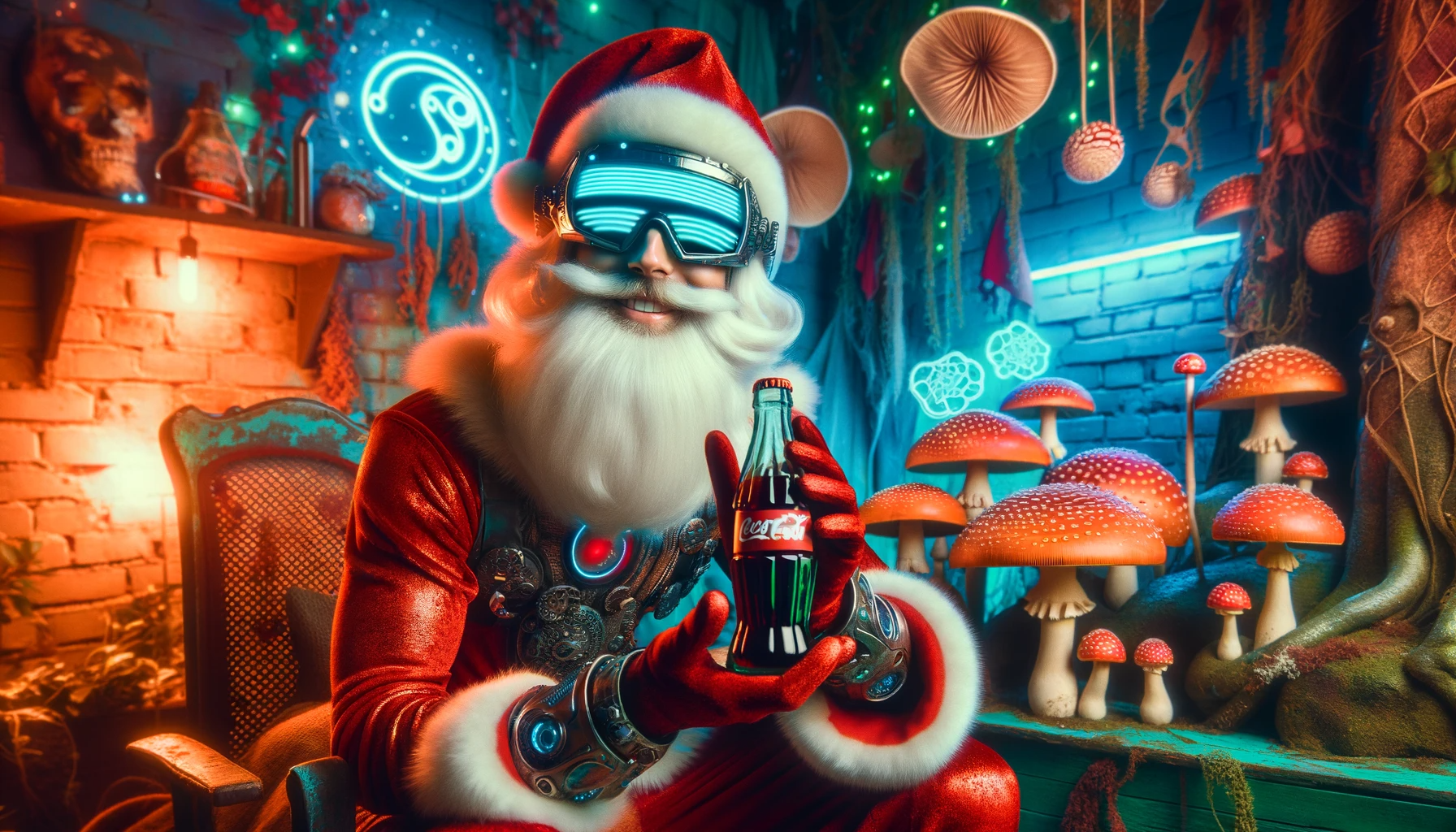
Wait What? What a stupid headline. Santa doesn’t exist!
Here is the audio version of my blog post:
Today is December 25th. In my culture people around me recognise December as Christmas time. That’s what I’ve been brought up with. Merry people, gifts, spending time with loved ones etc. And in my culture there’s a character called Santa Claus in people’s minds – or should I say that it’s a belief or idea that has been accepted as truth in a group consciousness, across the whole world even. Coca-Cola could be a main contributor to this. Coca-Cola is the most known brand in the world, and I would assume the company behind Coca-Cola finds Christmas-time very profitable since they are profiting on an image of a fictitious character called Santa Claus in red fluffy clothes drinking their product. And that keeps repeating yearly.
Every holiday season is commercialized. I might write about the marketing industry and the power of the mind eventually.
I want to give an example of how our minds work using a very current belief system being played out these days. I’m talking about Santa Claus.
Of course at one point in your formative years you wake up from the deception and lies about the existence of Santa. You realise you’ve been fooled and everyone around you is in on it. Just a simple and innocent lie. And it would be a shame to reveal it, and ruin the fun and thus you keep the illusion alive.
I can now see that awakening to our reality happens through layered levels of understanding. And it certainly requires courage to face new facts and integrate that.
We know that the physical brain grows into maturity as we become young adults. They say the brain is fully developed at the age around 28 but the mind and our understanding doesn’t grow at the same speed necessarily.
There’s stage 1 where we are taught as kids about Santa and his Naughty and Nice list. The joy of wishing and getting presents. Innocence. Not realizing that we were actually excitingly imagining ourselves already in the possession of the toy from the magazine. And if we were lucky, we would manifest it in 3D. Some people call that process the Law of Attraction.
Kids’ brains are in a constant trance state (theta wave) until they are around 8. That state of mind is also called hypnosis. And by now as adults we know from TV what skilled hypnotists can make people do. Unfortunately hypnosis is mostly known for its entertainment value.
Basically, our minds act like a sponge at this age, just absorbing everything without questions.
Stage 2 is when we find out that the white-bearded old man wearing red clothes doesn’t exist and we get confused. There’s a new gap between what we used to believe and what reality presents us with. That state of mind or confusion is what is called cognitive dissonance. That is the mental discomfort that results from holding two conflicting beliefs, values, or attitudes.
We eventually adjust to the new fact and new conversations about Santa with un-initiated are performed with a smile on our face. We might not put 2 and 2 together yet to start asking questions about it.
My daughter, already in 3rd grade still believes in Santa – or so she lets me know. At her age, I’m probably the one being fooled and played – ha, and I like it. What if she has matured enough to be able to turn around the joke. That’ll be a hilarious moment of realization for both of us.
If you want to read more about cognitive dissonance and what it means to us in daily life, I found a nice article about cognitive dissonance:
https://www.verywellmind.com/what-is-cognitive-dissonance-2795012
Stage 3 is when we realize and mostly unconsciously accept the consequences of this idea of presents especially at Christmas time. You follow the herd and accept that it is custom to buy in on the idea of Santa. Presents don’t manifest out of the blue in this reality.
Perhaps it’s also the same stage where you realise that it takes a resource called money to acquire those presents. Effort is required on your part.
If you are curious enough you start understanding about commercial interests and you learn about marketing and advertising as you see the effects after you’ve been to your grocery store returning with a bottle of Coca-Cola.
Perhaps you start digging into the history of Santa Claus and where he comes from. You may even start noticing that ads always show Santa Claus in red and white fluffy clothes. Reindeers are often shown as well.
As you dive deeper you might stumble upon the red and white mushroom the Amanita Muscaria, mistakenly called the magic mushroom. There’s a short video produced by the BBC about reindeers consuming the mushrooms and how some shamans use their urine for getting visions and insights. The video suggests a connection to Santa Claus because of the colors of his robe.
As you start doing your own research and get more and more comfortable with experiencing cognitive dissonance assessing two opposing beliefs at the same time, you might delve into deeper aspects of life affecting you on a daily basis. Philosophy might come up as a game changer at one point.
Compassion for other people and accepting their evolution becomes part of you as you yourself evolve.
At a later stage you realise you have options. You can decide what to believe. No one has the truth and everyone just pretends to know what’s going on. Most noticeably are government officials or news anchors on TV following the same script or success stories from surgically modified reality stars shared on social media.
As you can guess, the quest for innerstanding and exploration of personal truth is never ending. That is called personal development and it’s a huge industry. Most of it is pretty superficial and short sighted, I think.
It’s a process of discovering layers of beliefs and deciding consciously what to keep and what to let go of.
The concept of cognitive dissonance, exemplified by our changing beliefs about Santa Claus, isn’t just a childhood phenomenon. It’s a pervasive part of our adult lives too. As we grow, the dissonance extends to more complex areas – our careers, relationships, and even our understanding of health and politics.
I believe we are a species with amnesia. We’ve simply forgotten our true nature. We are eternal, multi-dimensional, universal, and immortal beings having a human experience.

We already have it all. We are not humans searching for a spiritual awakening. We are beings of spirit attempting to cope with a human awakening. There’s a huge difference and it’s a mindset shift.
This is a path of empowerment, taking responsibility for your own life one step at a time as you continuously explore your personal beliefs, values, and question the reality you experience.
But here’s the thing; you can only integrate what you know you know. Read that again. Awareness is key.
Seeking tools, seeking knowledge and gaining wisdom is essential in the process of undoing human conditioning.
Albert Einstein supposedly said: “No problem can be solved from the same level of consciousness that created it”. I’m starting to understand that quote in a broader sense now.
The case of Santa Claus is merely a very present and tangible concept to grasp. It’s just an example of what I call practical spirituality.
Our minds are easily manipulated and the marketing industry takes advantage of this. Marketers knew how the mind works way before psychiatrists did.
Our reality is filled with much deeper and profound mysteries.
Dive deeper into the realms of personal growth and spirituality by joining my newsletter. You’ll receive regular insights and be the first to learn about my upcoming online courses and trainings I’m developing.
Additionally, I’m exploring the possibility of offering one-to-one spiritual coaching for a more personalized guidance experience. As a newsletter subscriber, you’ll have exclusive access to these unique opportunities.
Sign up for the Newsletter at the bottom of the page.
As we wrap up this exploration of belief systems, let’s circle back to something that might seem trivial but is actually quite profound – the role of Coca-Cola in our Christmas narrative.
Coca-Cola has painted this jolly, red-suited Santa into our minds so well, it feels as if they had a hand in scripting part of our childhood. This isn’t just marketing; it’s a masterclass in weaving a brand into a cultural tapestry. It shows us just how powerfully a clever story, told by big corporations, can become a chapter in our collective belief system.
It leaves us with a question to ponder: In what other areas of our lives are large companies or organizations subtly influencing our beliefs and perceptions? The answer might surprise you.