
Living authentically with Human Design

My first glimpse of Human Design

I first encountered Human Design in early 2023, at a point where I was searching for something that could help me truly understand myself.
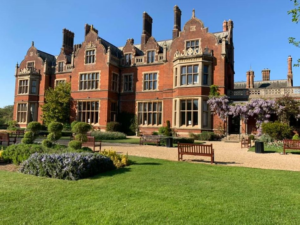
Arthur Findlay College

This journey started with a new friend I met at the Arthur Findlay College in early 2023. Both of us had signed up for a course on Trance Mediumship.
We’d spend evenings at the bar talking about things like psychedelics, UFOs, and our constant curiosity for what lies beneath the surface of life. Later on, he introduced me to Human Design – a system that, he said, could map out a person’s energy and purpose. Intrigued but skeptical, I figured I’d give it a try.

Before this, I didn’t have any real tool to navigate my life path. Personality tests like Myers-Briggs and the Enneagram offered some insights, but they only skimmed the surface.
I wanted a way to make sense of things, and Human Design offered a map, a guide I could try, fail, and keep exploring with.

Discovering my Generator energy

According to Human Design, I’m a pure Generator. That means I have a constant energy flow, almost like a rechargeable battery (Do you remember the Duracell commercial with the bunny?)
There’s a catch though: it’s not about just using energy. It’s about waiting for life to bring something to me that sparks that energy. And when something excites me, I can work without stopping, lose all track of time, and feel fully satisfied at the end of the day.

For instance, I’ll dive into a project, and before I know it, hours have passed. I forget to eat, drink, or even pause. I’m in the zone, I’m in a flow state. The work is energizing, not draining, because I’m fully in alignment with what excites me. But that’s only when I’m following what feels right; I’ve learned not to chase just anything. As a Generator, responding is the name of the game and I’m still figuring it out.

I’ve learned that not everything deserves my energy, and part of this journey is about letting life bring me the right opportunities. Learning to set boundaries is still a huge thing for me.

Navigating life as a 6/3 Profile – living in phases

In Human Design, I have a 6/3 profile, which combines two archetypes: the experimenter Line 3 and the role model Line 6.

For the first 28 years of my life, I was in the exploration phase – constantly experimenting, trying different paths, and learning through all the things that didn’t work. I was not conscious about any of this, to be honest!

Now, at 51, I’m supposed to step into the “role model” energy, though I’m still trying to understand what that actually looks like.

Looking back, I see it all so clearly. My life’s been one experiment after another – relationships that didn’t work out, career shifts, new business ventures, and endless side projects. For example, I got into entrepreneurship when I was 18, trying out different business models, failing at some, succeeding at others. It was all part of my process, and for the longest time, I thought I was just “unstable.” Now, I see it as part of my design. I was always meant to learn through experience.

Tuning into my sacral authority – trusting my body’s intelligence

With the insight of my profile, I also discovered the imporrtance of my decision making authority – my Sacral Authority. For Generators, this means I need to rely on my gut responses, a kind of “yes” or “no” that my body communicates. For me, these signals come as sounds – like a “mm-hmm” for yes or an “uh-uh” for no. This is not something I always knew I was doing, but now I listen for those responses more consciously.

Through plant medicine ceremonies, I’ve connected with this body intelligence on a deeper level. In one vision, it appeared to me as a woman I could talk to; a guide in my journey. She’s not as accessible in daily life, but the feeling stays with me, helping me to trust my body’s voice. Learning to listen to this voice, this presence, even outside of ceremony, is a whole journey in itself.

I’m new to this. I’ll be honest; I don’t have it down perfectly. Sometimes I even need reminders to listen to my body instead of my mind. I’ve printed exercises, stuck them on my fridge, trying to get the hang of it. But when I do listen, the answers feel like they’ve been there all along, just waiting for me to notice.

Learning to trust my body’s answers is a whole journey in itself. Sometimes I’ll ask myself a question, wait, and let the response come. It sounds almost too simple, but when I follow that yes or no from my sacral, my decisions feel right. It’s a process, and I’m still practicing. I’m far from perfect at this, but I’m learning.

Deep fears and limiting beliefs

Many fears have also come up to the surface during this last year. Some of these are deeply rooted, like the fear of not belonging or wondering if I’m “allowed” to even be here. These fears feel old, almost like they’ve been with me for lifetimes. And when I go deeper, I wonder if they’re passed down through family lines.

There’s a kind of freedom in acknowledging them without needing to “fix” them. Inspired by Ram Dass in a beautiful track by East Forest, I’ve learned to just “love my dark thoughts.” He talks about sitting with those difficult thoughts, observing them without judgment and just state “I love my dark thoughts”.

So when one of those old fears rises, I try to welcome it, let it be, and then let it go. I’m not trying to rid myself of these fears, just seeing them as part of my journey.

Psychedelics, fears, and generational healing

I’ve spent time working with plant medicines like Ayahuasca and psilocybin mushrooms. They’ve opened me up to the idea that some fears might not even be mine. These experiences make me consider how our energies get passed down, from ancestors to us.

Part of my healing process has been to just stop pointing fingers – to see it all as energy I can choose to hold onto or let go.

I acknowledge that neither my parents nor my grandparents had any tools to process such fears or even the awareness to see the patterns.

I sometimes imagine that by working with these fears, I’m breaking a chain. That’s where I find some peace: knowing that I’m doing the work of realisation here, within me, so I don’t pass it on.

Sharing my process as it unfolds

I made the choice to “build in public,” not because I have all the answers but because I’m curious, and I think curiosity is contagious. I’m writing and sharing my journey so others can see that it’s okay to explore without a clear destination. Maybe my story will inspire someone else to look into their Human Design, or maybe it will just make people feel less alone in their own self-discovery process.

One tool that’s helped in all of this is metacognition – the practice of watching my own thought patterns. I’ve started stepping back and observing, not getting wrapped up in the fears but just watching them come and go.
I love Ram Dass’ approach to ‘loving dark thoughts.’ He says, ‘Just love them, welcome them as they are.’ I use this practice when I catch myself in fear or self-doubt, and it gives me a freedom I didn’t have before.

So if you’re intrigued, get a Human Design chart done. It’s not about having it all figured out; it’s about being open to the process and seeing where it takes you.

Living authentically

Human Design hasn’t solved my problems, but it has helped me find a way to live that feels truer to myself.
I’m still figuring this out, day by day. I don’t have it all together, and I’m learning to be okay with that. It’s a tool, a way to make choices that come from within, instead of following what’s expected.

This journey isn’t about achieving some end goal. It’s about staying open, experimenting, and being honest with myself about where I am. If my experiences help others along their path, even better. So here’s to living authentically – without the pressure to have it all figured out.
The inner compass of Human Design

Human Design - Inner compass

Are you seeking a deeper understanding of yourself, navigating the crossroads of happiness and purpose?

Almost two years ago, a friend introduced me to Human Design, and since then, I’ve been deep-diving into what I now call my Inner Compass.

If you’re interested in psychology and personality types, I can highly recommend Human Design. Perhaps you’ve heard of the 16 personalities (Meyer-Briggs Type Indicator), Enneagram, DiSC or other personal assessment tools. 

While these tools provided helpful insights, they felt like puzzle pieces that didn’t quite fit together.

Human Design, however, offered me a map – a living, breathing system that shows how my energy interacts with life in real-time.

Even my astrological zodiac sign Sagittarius served as a general lighthouse until recently.

I’ve been on the spiritual discovery path for over 30 years and I thought I knew something about most of the personal development topics. I had never stumbled upon Human Design which was brought into this world in 1992 by a man called Ra Uru Hu.

Human Design is a comprehensive self-knowledge system. It’s a system for self-discovery and personal growth. It provides a practical map of how individuals operate, based on their unique design.

It’s a system that helps you align with your true self. Think of it as a user manual for navigating life’s challenges and opportunities. By understanding your unique design, you learn how to make better decisions, find your strengths, and work through challenges.

The system integrates various ancient wisdom traditions, including western astrology, the I Ching, Kabbalah, and Vedic philosophy. It also adds modern scientific insights such as genetics and neutrinos.

Based on your birthday, time and location, this system is able to provide a much deeper analysis of who you are, and what gifts you bring to this world.

Skeptical but curious, I decided to create my own chart.

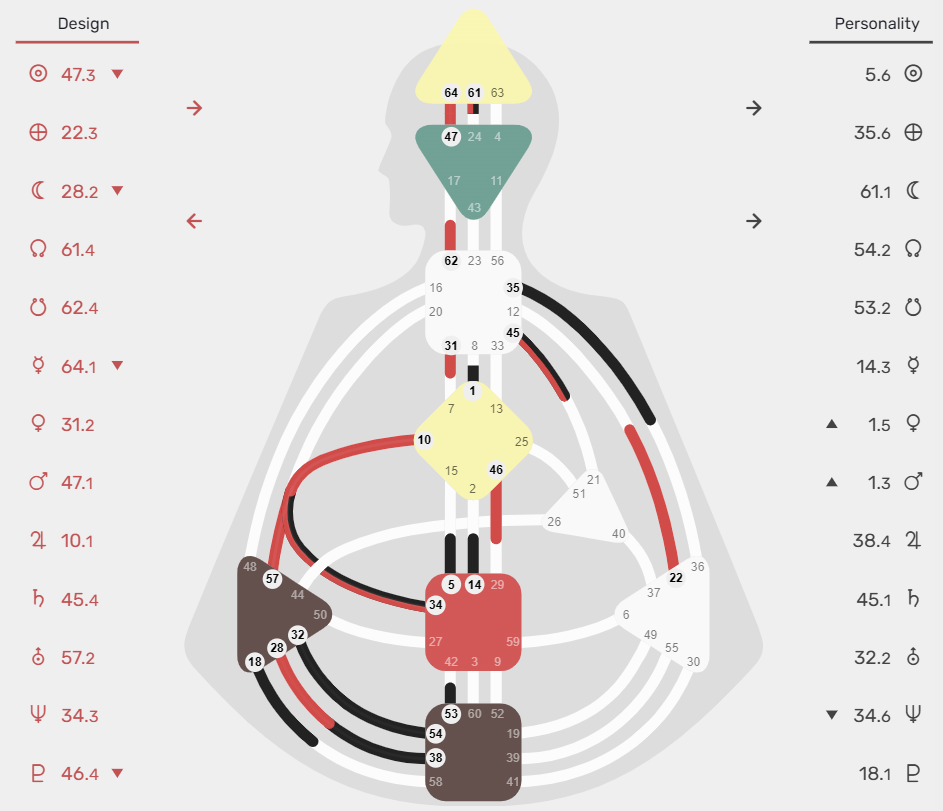
Human Design Body graph

At first, it looked like something out of a cartoon. But as I dug deeper, I started seeing its structure and meaning.

For instance the colors of the number columns were important and the 9 shapes (energy centers) had different meanings if they were colored-in or not.

After I inspected my chart and read the high-level explanations of the basic parts, I got curious.

Five types – Discovering I’m a generator

In the Human Design system, developed by Ra Uru Hu, individuals are categorized into five distinct energy types: Generators, Manifesting Generators, Projectors, Manifestors, and Reflectors. 

Among these, Generators and Manifesting Generators are considered receptive types. They respond to the world around them and derive energy from their environment. They are designed to respond to life instead of initiating actions.

Approximately 70% of the population consists of Generators, with pure Generators making up around 37% and Manifesting Generators around 33%​. They rely on their “gut-feeling” when responding to life.

All types have strengths and challenges, and that is what really got me deep diving.

I found several websites where I could create my own Human Design chart for free. See links at the end for resources. 

I learned that I’m a 6/3 Generator. According to Human Design, a 6/3 Generator is a dynamic individual who learns through experience and embodies the wisdom gained from their journey.

Generators thrive on responding to life rather than initiating actions. This allows them to engage deeply with their passions and find satisfaction in their work.

What fascinates me, compared to the Enneagram or the MBTi is that Human Design offers practical guidance on how to navigate life. For me as a Generator, to live an authentic life, I should respond to life rather than initiate.

I’ve read countless books on Human Design to better understand what waiting to respond, not initiating means. Currently being without work and applying for jobs for me equalled initiating. But it’s the other way around. 

I’m responding to a job ad and I use my gut feeling to determine if the job is a good match.

Exploring your own Human Design chart

Here are the top things to look at in your chart:

Type
Your type shows how you interact with the world. Are you a Generator, Projector, Manifestor, or Reflector? Each type has its own way of engaging with life and making decisions.

Strategy
Your strategy is how you’re meant to approach life. Generators, for example, should wait to respond, while Manifestors are meant to initiate. This is key to finding flow and avoiding frustration.

Authority
Authority is how you make decisions. Some people listen to their gut (like me, with Sacral Authority), others wait for emotional clarity, or trust their instincts. Understanding your authority helps you know when something is truly right for you.

Profile
Your profile reveals the role you play in life and how others see you. It’s made up of two numbers, like 6/3 or 5/1. It tells you how you learn, relate to others, and grow through life experiences.

Centers
The nine centers in your chart are like energy hubs. If they’re colored in (defined), they’re areas of consistent energy. If they’re white (undefined), you’re open to influence from others in those areas. Understanding your centers helps you know your strengths and where you might be influenced.

For example, I have a defined Sacral Center. This means I have consistent access to life-force energy. 

This is the energy that fuels my work and passions, allowing me to sustain effort over time. 

On the other hand, my throat center is undefined, which means my ability to express myself varies depending on who I’m with. 

This variability has helped me learn to listen before speaking, and to allow my words to emerge naturally when the timing is right.

When I read about the undefined throat center, and how I adapt to my surroundings, I got so many aha-moments. A lot of situations from my childhood and adult life suddenly made sense to me. 

As a young child I lived in Cairo for 8 months and I learned to speak Arabic like the natives. As soon as I returned to Denmark and landed at the Copenhagen Airport, I adapted to my new local environment and forgot all about Arabic! Haven’t spoken it since.

Incarnation Cross
This is one of the most important parts of your chart—it’s your life purpose. The Incarnation Cross gives you insight into the direction of your life. It shows what you’re here to do and the unique gifts you bring to the world.

Gates and Channels (for deeper analysis!)
Gates and channels connect the centers in your chart. They represent specific energies and traits. Gates can highlight your gifts or challenges, and channels show how your energy flows between different parts of your life.

Deconditioning

As I’m working with Human Design, I’ve realized it’s not just a system for making better decisions – it’s a spiritual process of deconditioning.

We’ve absorbed layers of conditioning from society, family, and our environment, pulling us away from who we truly are. It takes a bit of soul searching to accept this fact. Best part? I’ve found a good tool to help me.

Human Design offers a pathway to peel back these layers, allowing your authentic self to shine through. It’s a journey from mind-centered living to heart-centered awareness, where you stop reacting to external pressures and begin responding from a place of inner truth.

At the same time, it’s important to remember:

Human Design is a tool, not a rulebook. It’s meant to help you understand yourself better.
But life isn’t about overthinking your design. It’s about engaging with the world, experiencing joy, and trusting your instincts.

So while Human Design offers profound insights, don’t forget to live, explore, and follow your own unique path.

What’s next?

If you’re curious about your own Human Design, I encourage you to explore it for yourself. Below are some resources to generate your chart and start your journey:

https://jovianarchive.com

This is the official website of Human Design and only provides the most basic information about your profile. It doesn’t provide any details about your unique setup.

https://www.myhumandesign.com

Here you get a bit more information about the basic data of your chart.