Living authentically with Human Design

My first glimpse of Human Design

I first encountered Human Design in early 2023, at a point where I was searching for something that could help me truly understand myself.

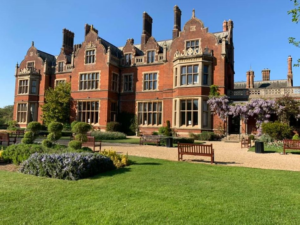
Arthur Findlay College

This journey started with a new friend I met at the Arthur Findlay College in early 2023. Both of us had signed up for a course on Trance Mediumship.
We’d spend evenings at the bar talking about things like psychedelics, UFOs, and our constant curiosity for what lies beneath the surface of life. Later on, he introduced me to Human Design – a system that, he said, could map out a person’s energy and purpose. Intrigued but skeptical, I figured I’d give it a try.

Before this, I didn’t have any real tool to navigate my life path. Personality tests like Myers-Briggs and the Enneagram offered some insights, but they only skimmed the surface.
I wanted a way to make sense of things, and Human Design offered a map, a guide I could try, fail, and keep exploring with.

Discovering my Generator energy

According to Human Design, I’m a pure Generator. That means I have a constant energy flow, almost like a rechargeable battery (Do you remember the Duracell commercial with the bunny?)

There’s a catch though: it’s not about just using energy. It’s about waiting for life to bring something to me that sparks that energy. And when something excites me, I can work without stopping, lose all track of time, and feel fully satisfied at the end of the day.

For instance, I’ll dive into a project, and before I know it, hours have passed. I forget to eat, drink, or even pause. I’m in the zone, I’m in a flow state. The work is energizing, not draining, because I’m fully in alignment with what excites me. But that’s only when I’m following what feels right; I’ve learned not to chase just anything. As a Generator, responding is the name of the game and I’m still figuring it out.

I’ve learned that not everything deserves my energy, and part of this journey is about letting life bring me the right opportunities. Learning to set boundaries is still a huge thing for me.

Navigating life as a 6/3 Profile – living in phases

In Human Design, I have a 6/3 profile, which combines two archetypes: the experimenter Line 3 and the role model Line 6.

For the first 28 years of my life, I was in the exploration phase – constantly experimenting, trying different paths, and learning through all the things that didn’t work. I was not conscious about any of this, to be honest!

Now, at 51, I’m supposed to step into the “role model” energy, though I’m still trying to understand what that actually looks like.

Looking back, I see it all so clearly. My life’s been one experiment after another – relationships that didn’t work out, career shifts, new business ventures, and endless side projects. For example, I got into entrepreneurship when I was 18, trying out different business models, failing at some, succeeding at others. It was all part of my process, and for the longest time, I thought I was just “unstable.” Now, I see it as part of my design. I was always meant to learn through experience.

Tuning into my sacral authority – trusting my body’s intelligence

With the insight of my profile, I also discovered the imporrtance of my decision making authority – my Sacral Authority. For Generators, this means I need to rely on my gut responses, a kind of “yes” or “no” that my body communicates. For me, these signals come as sounds – like a “mm-hmm” for yes or an “uh-uh” for no. This is not something I always knew I was doing, but now I listen for those responses more consciously.

Through plant medicine ceremonies, I’ve connected with this body intelligence on a deeper level. In one vision, it appeared to me as a woman I could talk to; a guide in my journey. She’s not as accessible in daily life, but the feeling stays with me, helping me to trust my body’s voice. Learning to listen to this voice, this presence, even outside of ceremony, is a whole journey in itself.

I’m new to this. I’ll be honest; I don’t have it down perfectly. Sometimes I even need reminders to listen to my body instead of my mind. I’ve printed exercises, stuck them on my fridge, trying to get the hang of it. But when I do listen, the answers feel like they’ve been there all along, just waiting for me to notice.

Learning to trust my body’s answers is a whole journey in itself. Sometimes I’ll ask myself a question, wait, and let the response come. It sounds almost too simple, but when I follow that yes or no from my sacral, my decisions feel right. It’s a process, and I’m still practicing. I’m far from perfect at this, but I’m learning.

Deep fears and limiting beliefs

Many fears have also come up to the surface during this last year. Some of these are deeply rooted, like the fear of not belonging or wondering if I’m “allowed” to even be here. These fears feel old, almost like they’ve been with me for lifetimes. And when I go deeper, I wonder if they’re passed down through family lines.

There’s a kind of freedom in acknowledging them without needing to “fix” them. Inspired by Ram Dass in a beautiful track by East Forest, I’ve learned to just “love my dark thoughts.” He talks about sitting with those difficult thoughts, observing them without judgment and just state “I love my dark thoughts”.

So when one of those old fears rises, I try to welcome it, let it be, and then let it go. I’m not trying to rid myself of these fears, just seeing them as part of my journey.

Psychedelics, fears, and generational healing

I’ve spent time working with plant medicines like Ayahuasca and psilocybin mushrooms. They’ve opened me up to the idea that some fears might not even be mine. These experiences make me consider how our energies get passed down, from ancestors to us.

Part of my healing process has been to just stop pointing fingers – to see it all as energy I can choose to hold onto or let go.

I acknowledge that neither my parents nor my grandparents had any tools to process such fears or even the awareness to see the patterns.

I sometimes imagine that by working with these fears, I’m breaking a chain. That’s where I find some peace: knowing that I’m doing the work of realisation here, within me, so I don’t pass it on.

Sharing my process as it unfolds

I made the choice to “build in public,” not because I have all the answers but because I’m curious, and I think curiosity is contagious. I’m writing and sharing my journey so others can see that it’s okay to explore without a clear destination. Maybe my story will inspire someone else to look into their Human Design, or maybe it will just make people feel less alone in their own self-discovery process.

One tool that’s helped in all of this is metacognition – the practice of watching my own thought patterns. I’ve started stepping back and observing, not getting wrapped up in the fears but just watching them come and go.
I love Ram Dass’ approach to ‘loving dark thoughts.’ He says, ‘Just love them, welcome them as they are.’ I use this practice when I catch myself in fear or self-doubt, and it gives me a freedom I didn’t have before.

So if you’re intrigued, get a Human Design chart done. It’s not about having it all figured out; it’s about being open to the process and seeing where it takes you.

Living authentically

Human Design hasn’t solved my problems, but it has helped me find a way to live that feels truer to myself.
I’m still figuring this out, day by day. I don’t have it all together, and I’m learning to be okay with that. It’s a tool, a way to make choices that come from within, instead of following what’s expected.

This journey isn’t about achieving some end goal. It’s about staying open, experimenting, and being honest with myself about where I am. If my experiences help others along their path, even better. So here’s to living authentically – without the pressure to have it all figured out.

The inner compass of Human Design

Human Design - Inner compass

Are you seeking a deeper understanding of yourself, navigating the crossroads of happiness and purpose?

Almost two years ago, a friend introduced me to Human Design, and since then, I’ve been deep-diving into what I now call my Inner Compass.

If you’re interested in psychology and personality types, I can highly recommend Human Design. Perhaps you’ve heard of the 16 personalities (Meyer-Briggs Type Indicator), Enneagram, DiSC or other personal assessment tools. 

While these tools provided helpful insights, they felt like puzzle pieces that didn’t quite fit together.

Human Design, however, offered me a map – a living, breathing system that shows how my energy interacts with life in real-time.

Even my astrological zodiac sign Sagittarius served as a general lighthouse until recently.

I’ve been on the spiritual discovery path for over 30 years and I thought I knew something about most of the personal development topics. I had never stumbled upon Human Design which was brought into this world in 1992 by a man called Ra Uru Hu.

Human Design is a comprehensive self-knowledge system. It’s a system for self-discovery and personal growth. It provides a practical map of how individuals operate, based on their unique design.

It’s a system that helps you align with your true self. Think of it as a user manual for navigating life’s challenges and opportunities. By understanding your unique design, you learn how to make better decisions, find your strengths, and work through challenges.

The system integrates various ancient wisdom traditions, including western astrology, the I Ching, Kabbalah, and Vedic philosophy. It also adds modern scientific insights such as genetics and neutrinos.

Based on your birthday, time and location, this system is able to provide a much deeper analysis of who you are, and what gifts you bring to this world.

Skeptical but curious, I decided to create my own chart.

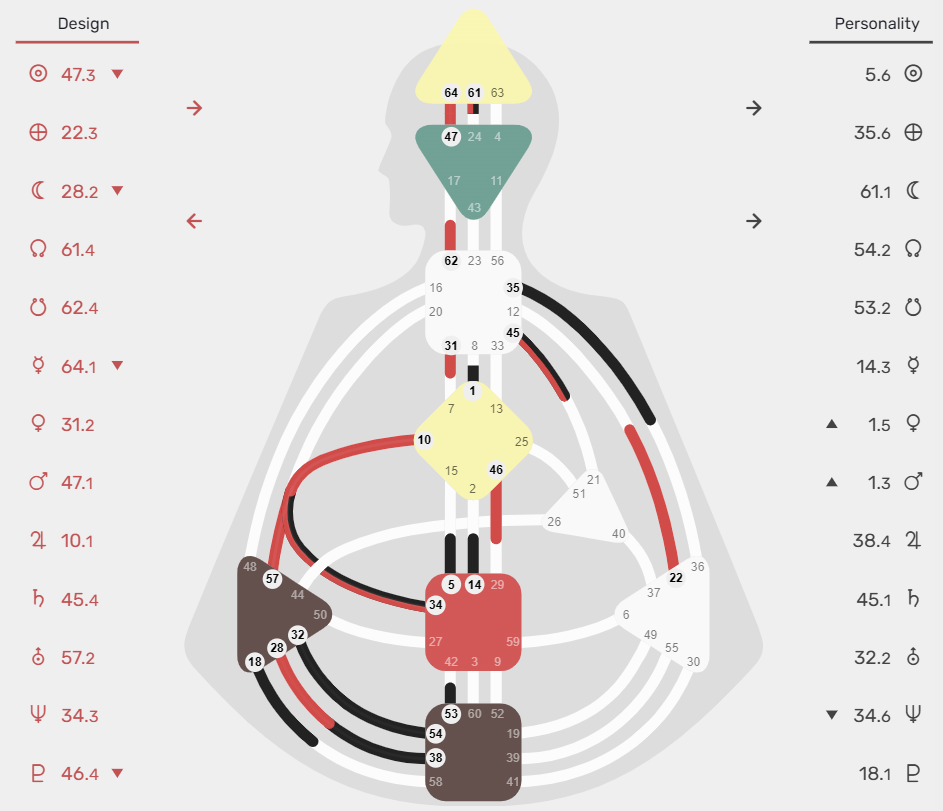
Human Design Body graph

At first, it looked like something out of a cartoon. But as I dug deeper, I started seeing its structure and meaning.

For instance the colors of the number columns were important and the 9 shapes (energy centers) had different meanings if they were colored-in or not.

After I inspected my chart and read the high-level explanations of the basic parts, I got curious.

Five types – Discovering I’m a generator

In the Human Design system, developed by Ra Uru Hu, individuals are categorized into five distinct energy types: Generators, Manifesting Generators, Projectors, Manifestors, and Reflectors. 

Among these, Generators and Manifesting Generators are considered receptive types. They respond to the world around them and derive energy from their environment. They are designed to respond to life instead of initiating actions.

Approximately 70% of the population consists of Generators, with pure Generators making up around 37% and Manifesting Generators around 33%​. They rely on their “gut-feeling” when responding to life.

All types have strengths and challenges, and that is what really got me deep diving.

I found several websites where I could create my own Human Design chart for free. See links at the end for resources. 

I learned that I’m a 6/3 Generator. According to Human Design, a 6/3 Generator is a dynamic individual who learns through experience and embodies the wisdom gained from their journey.

Generators thrive on responding to life rather than initiating actions. This allows them to engage deeply with their passions and find satisfaction in their work.

What fascinates me, compared to the Enneagram or the MBTi is that Human Design offers practical guidance on how to navigate life. For me as a Generator, to live an authentic life, I should respond to life rather than initiate.

I’ve read countless books on Human Design to better understand what waiting to respond, not initiating means. Currently being without work and applying for jobs for me equalled initiating. But it’s the other way around. 

I’m responding to a job ad and I use my gut feeling to determine if the job is a good match.

Exploring your own Human Design chart

Here are the top things to look at in your chart:

Type
Your type shows how you interact with the world. Are you a Generator, Projector, Manifestor, or Reflector? Each type has its own way of engaging with life and making decisions.

Strategy
Your strategy is how you’re meant to approach life. Generators, for example, should wait to respond, while Manifestors are meant to initiate. This is key to finding flow and avoiding frustration.

Authority
Authority is how you make decisions. Some people listen to their gut (like me, with Sacral Authority), others wait for emotional clarity, or trust their instincts. Understanding your authority helps you know when something is truly right for you.

Profile
Your profile reveals the role you play in life and how others see you. It’s made up of two numbers, like 6/3 or 5/1. It tells you how you learn, relate to others, and grow through life experiences.

Centers
The nine centers in your chart are like energy hubs. If they’re colored in (defined), they’re areas of consistent energy. If they’re white (undefined), you’re open to influence from others in those areas. Understanding your centers helps you know your strengths and where you might be influenced.

For example, I have a defined Sacral Center. This means I have consistent access to life-force energy. 

This is the energy that fuels my work and passions, allowing me to sustain effort over time. 

On the other hand, my throat center is undefined, which means my ability to express myself varies depending on who I’m with. 

This variability has helped me learn to listen before speaking, and to allow my words to emerge naturally when the timing is right.

When I read about the undefined throat center, and how I adapt to my surroundings, I got so many aha-moments. A lot of situations from my childhood and adult life suddenly made sense to me. 

As a young child I lived in Cairo for 8 months and I learned to speak Arabic like the natives. As soon as I returned to Denmark and landed at the Copenhagen Airport, I adapted to my new local environment and forgot all about Arabic! Haven’t spoken it since.

Incarnation Cross
This is one of the most important parts of your chart—it’s your life purpose. The Incarnation Cross gives you insight into the direction of your life. It shows what you’re here to do and the unique gifts you bring to the world.

Gates and Channels (for deeper analysis!)
Gates and channels connect the centers in your chart. They represent specific energies and traits. Gates can highlight your gifts or challenges, and channels show how your energy flows between different parts of your life.

Deconditioning

As I’m working with Human Design, I’ve realized it’s not just a system for making better decisions – it’s a spiritual process of deconditioning.

We’ve absorbed layers of conditioning from society, family, and our environment, pulling us away from who we truly are. It takes a bit of soul searching to accept this fact. Best part? I’ve found a good tool to help me.

Human Design offers a pathway to peel back these layers, allowing your authentic self to shine through. It’s a journey from mind-centered living to heart-centered awareness, where you stop reacting to external pressures and begin responding from a place of inner truth.

At the same time, it’s important to remember:

Human Design is a tool, not a rulebook. It’s meant to help you understand yourself better.
But life isn’t about overthinking your design. It’s about engaging with the world, experiencing joy, and trusting your instincts.

So while Human Design offers profound insights, don’t forget to live, explore, and follow your own unique path.

What’s next?

If you’re curious about your own Human Design, I encourage you to explore it for yourself. Below are some resources to generate your chart and start your journey:

https://jovianarchive.com

This is the official website of Human Design and only provides the most basic information about your profile. It doesn’t provide any details about your unique setup.

https://www.myhumandesign.com

Here you get a bit more information about the basic data of your chart.

Unlock spiritual leadership with new science

Spiritual Leadership Claus Reestrup


Let’s talk about consciousness. I watched a TED talk recently about plant communication. A neuroscientist Greg Gage found a way to communicate with plants. As we all know, plants don’t have a brain nevertheless the scientist found that plants use electrical signals to interact with their environment, much like our own nervous system.

Neuroscientist and plant communication

In the experiment Greg Gage interacts with a plant called the Venus fly trap. It’s the plant that catches insects with its leafs. The plant has small hair-like antennas which causes the lobes to snap shut when prey touches them.

A Venus flytrap

The scientist proofs that the plant can count. It only closes if the antennas are stimulated rapidly as if a fly is there. Greg shows that touching an antenna only once doesn’t make the plant close. And apparently the flytrap only shuts if the antennas are stimulated quickly within a 20-second period.

Now, that is a sign of intelligence in the natural world, and I find that very fascinating.

Interestingly, the experiments are based on facts. No belief system is needed to get the results. It is part of our existence whether you believe it or not. Plants are nature – and so are we.

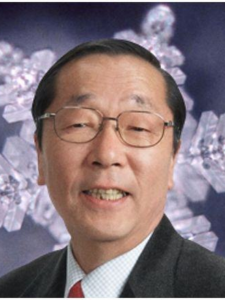
Dr Masaru Emoto

Dr Masaru Emoto, a Japanese scientist with a PhD in alternative medicine, proved that human consciousness could affect the structure of water. That is how powerful the mind is.

In his studies, he found that water exposed to positive words and intentions formed beautiful, symmetrical crystalline structures when the water was frozen, while water exposed to negative words and intentions formed disorganized, asymmetrical structures.

He did an experiment with rice where he poured water over cooked rice in three different jars, then labeling one “Thank You!,” one “You’re An Idiot,” and leaving one unlabeled. He found that the rice that he spoke kind words to remained mostly white, while the rice that he spoke negatively to, turned moldy, providing physical evidence of the power of positivity.

This works without needing a certain belief system. Fact based.

The Gaia tv-show has made a good video on water consciousness and how water responds to human emotion.

Water responds to human emotion. Power of the mind. (c) Gaia

Furthermore, I’m fascinated by some of the experiments done by a woman called Veda Austin. Her website is titled The Secret Intelligence of Water.

Veda Austin

Veda is a water researcher and public speaker and she has experimented with frozen water and the power of the mind for the last 10 years.

She believes that water is fluid intelligence, observing itself through every living organism on the planet and in the Universe.

​Her primary area of focus is photographing water in its ‘state of creation’, the space between liquid and ice. It is through her remarkable photos that water reveals its awareness of not only creation, but thought and intention through imagery.

In her video on her website, she explains “water appears to intelligently respond to human consciousness. It uses its building blocks of ice to design recognizable pictographs enabling it to share its messages or acknowledgement back to us in picture form.”

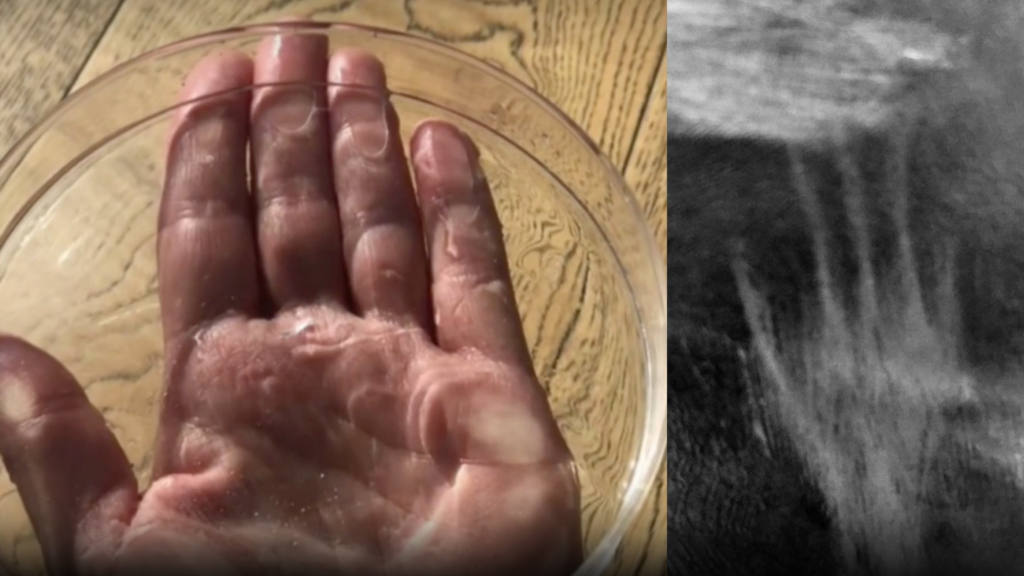
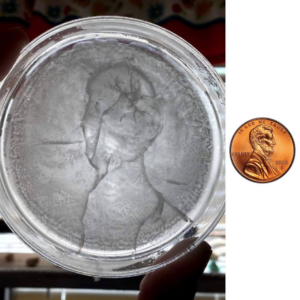
She continues: “My first experience of this phenomenon was when I projected the thought of my hand into a petri dish of water, froze it, pulled it out, and in the architecture of the ice was a hand.”

Hand projected into water and visible in the frozen water. (c) Veda Austin

Take a look of some of her experiments with water consciousness. She has over 40.000 pictures, according to her website.

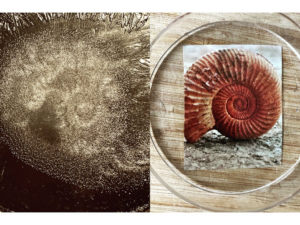
It seems water in frozen state is able to create a representation of physical objects. Water even picks up thoughts, music, words and photos. Here are a few of her results, copyright Veda Austin.

(C) Vera Austin
(C) Vera Austin
(C) Vera Austin
(C) Vera Austin

Amazing, isn’t it? Pure science again. No belief system required, only consciousness and perhaps an open mind.

Thirdly, electricity is required for the human nervous system to send signals throughout the body and to the brain, making it possible for us to move, think, and feel. Part of the human body is electric and with electric impulses comes electromagnetism.

Are you still doubting that your thoughts are energy?

New groundbreaking technologies are being developed that makes it possible to control external devices through thoughts. This technology is called Brain-Computer Interface or BCI which is a computer-based system that acquires brain signals, analyzes them, and translates them into commands that are relayed to an output device to carry out a desired action.
This is no longer science-fiction but science-facts.
These systems can operate many different devices, from cursors on computer screens to wheelchairs to robotic arms. These kind of devices are not mind-readers – they work by reading and analysing electrical brain signals using advanced technologies like EEG.

If you’re a science buff, you can read more about Brain-Computer Interfaces here: Brain-Computer Interfaces in Medicine. This research from 2012 is published in an official US government website called National Library of Medicine – National Center for Biotechnology Information.

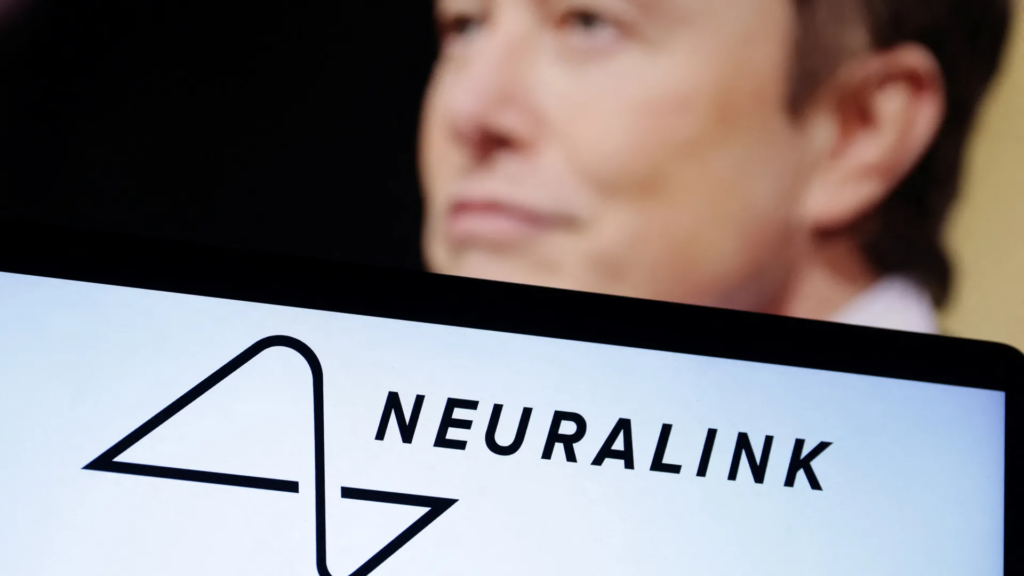
Elon Musk owns a company called Neuralink where they are developing such a brain-computer interface. That solution is an implant in the brain though.

Neuralink and Elon Musk

The company mission statement is “Create a generalized brain interface to restore autonomy to those with unmet medical needs today and unlock human potential tomorrow.”
Elon Musk has reportedly said he wants humans to merge with AI “to achieve a symbiosis with artificial intelligence.”

This sounds really great, but I don’t like the idea of implanting technology inside my body. Especially technology that I have not created myself nor have any control of. Such implants receive a lot of resistance from free-thinkers expressing their concerns about transhumanism.

What Elon Musk talks about is not just reading the brain signals but also writing the signals back to the brain meaning that a piece of technology sends or writes signals to your brain. To me that raises a lot concern when considered beyond the context of helping the blind see or the handicapped walk. Who would decide what signals were “written” and sent to the brain?

Integrating science, spirituality, and leadership for the future

The science of plant communication, studies on human consciousness, and the potential of brain-computer interfaces, I find is very relevant for young business leaders.

This combination of science and spirituality might seem outside the norm for the business world and unfortunately we have forgotten our spiritual heritage and we’ve gotten absorbed in materialism, profits, and greed. We’ve forgotten why we’re here and what we are in essence.

If we want to build a better world, we must get to know ourselves and our surroundings first. Part of a leadership training programme should include spirituality, neuroscience, and consciousness studies. We can’t lead blindly anymore.
I’m bringing cutting-edge research to support a new paradigm.

Our consciousness can affect water, and with the plant communication research, we can certainly see that reality is stranger than fiction.

Emotional intelligence, particularly self-awareness, gives you tools to lead from a place of positivity and inspiration. Understanding ourselves as spiritual beings brings a sense of purpose, empathy, and compassion to our roles as leaders.

Embracing a holistic view of leadership, grounded in both science and spirituality offers many benefits.

As a leader, are you aware of your intentions and emotions when you talk to people? 
As you can see, like plants, you give off electricity that others pick up. It’s that vibe or feeling we get when we either feel something is off with a person or we naturally resonate with him or her. Mystics call this the aura that most are able to pick up in one form or the other.

Self-awareness is part of emotional intelligence (aka EQ or EI). Being aware of your own state of mind when you motivate people, when you are struggling with conflict, when you lead. 
Plants communicate through non-verbal signals, which is a crucial aspect of emotional intelligence. Leaders must learn to read and interpret non-verbal cues from their team members, such as body language and facial expressions.

Apart from enhanced creativity and innovation, emotional intelligence and spiritual awareness help leaders build deeper connections with team members, enhancing trust, collaboration, and collective problem-solving.

I’m here to challenge the status quo and to inspire open minded leaders. We need more critical thinkers and doers. I’m talking about education, and not indoctrination. I call it Spiritual Leadership and this is what I’m offering.

Join my newsletter to be among the first to hear about my upcoming courses and offers.

How to bridge intelligence with spiritual awareness

Emotional intelligence


Here is the audio version of this blog post:

Scientists like to measure, label, and conceptualize natural behavior. Among such brilliant undertakings is the concept of intelligence quotient, more popularly known as IQ. Most of us have heard about IQ as a number indicating what we call intelligence. The higher the better. I’m pretty sure names like Albert Einstein or Elon Musk pop into your mind as you read this. That’s what Google suggests when I do a search. Google knows what people are searching for and shows related searches that you can do. Google is intelligent.

If you are among the top 2% of people scoring very well on two IQ tests called Stanford-Binet and Cattell you can become part of a high-IQ society called Mensa International. Wow, eh?

We associate a high IQ with being smart and living a high quality of life, don’t we?

In November 2023 I quit my job in IT as a senior team leader in a large international corporation. It was a well paid job with good benefits but I felt my managers breathing down my neck pushing the agenda of working harder to make my teams more efficient. I felt I had to sacrifice the well-being of my team members and I didn’t like that in any way. In the end, I sacrificed my own wellbeing.  

Although my managers had the word ‘leader’ in their job title, it didn’t mean they were good at what they were supposed to be doing; leading, not managing. To me, there’s a world of difference.

In the summer of 2023 I participated in a 4-day ayahuasca workshop where it became clear that I needed to change my work life. I did get visions of my future but as with psychic predictions and dreams, they can be very symbolic and need interpretation or hindsight to understand. The South American jungle brew ayahuasca gives you what you need, not what you think you need. The shamans or curanderos call it a medicine for the soul and purging what no longer serves you is part of the cleansing process. And at that workshop I purged a lot. 

Although I had become aware of the need for change in my work life, it took me a lot of time and introspection in the following months to finally decide to courageously quit without a backup plan. One of the first days of November I quit and I no longer wanted to be energetically connected with that workplace. I could have quit and called in sick during my notice period but that would not align with my values of being true to myself and being authentic. I got out of my contract within days opposed to a 2 month notice period.

The day after I quit, my intuition about my closest managers and their lack of empathy was confirmed. I received an impersonal “I wish you well” email that was clearly generated by a language tool like ChatGPT and copy-pasted without proof reading or personalizing it. 

Some of my friends couldn’t relate to my decision and my reasons for quitting so suddenly. Surely I could have stayed during the notice period giving me time to find a new job and just cope. That would have been the intelligent way of handling the situation.

Intelligence again.
Pure intelligence isn’t everything.

IQ represents a measure of one’s cognitive or intellectual intelligence, indicating how well a person can use reasoning and logic to solve problems. Emotional intelligence (EQ), on the other hand, measures emotional intelligence, focusing on one’s ability to manage both their own and others’ emotions effectively. Social skills and empathy included. Both are valuable, and in many cases, EQ is considered equally if not more important than IQ in contributing to a person’s success and happiness in life. Emotional intelligence is a very big thing in leadership positions. According to hundreds of CEOs the most important intelligence is the emotional intelligence. IQ is needed to get the leadership job, and EQ is needed to make the organisation flourish.

Daniel Goleman, an American psychologist, author, and science journalist worked at New York Times where he covered psychology, emotions, and the brain. Among his most known contributions to humanity is his work on emotional intelligence. It became a New York bestseller and his first book has since been translated to over 40 languages. Today his book is regarded as one of the top 25 most pivotal books in the realm of business management.

Recently I watched an interview where he was asked what to do if your boss has no EQ. First of all he advised not to tell your boss directly. Then he said there were two options only; Either give your feedback through an ally who is able to talk to your boss and who your boss respects. Or, get your boss’s resumé and send it to an executive recruiter and they might get a good job somewhere else. This last part I will remember going forward. I just wish I had heard about this ages ago. Very tangible and practical advice.

Best part about emotional intelligence is that contrary to IQ which stays roughly stable during a lifetime, emotional intelligence can be developed and enhanced through experience, reflection, and conscious practice.

Heck, there’s even something called Spiritual Intelligence, which I’ve just discovered recently.

Let’s peek into a little rabbit hole now, just for curiosity’s sake.

Have you ever heard about the work of Dolores Cannon? Her career as a hypnotherapist specializing in past life regression spanned almost 50 years. She has written extensively on topics covering reincarnation, ETs, and the nature of reality. Dolores invented a process called Quantum Healing Hypnosis Technique (QHHT).
https://dolorescannon.com/about-qhht/

She experienced a greater intelligence talking through the hypnotized people she was helping. That greater intelligence gave her small pieces of a larger puzzle with every client she hypnotized. She started gathering this information and found out that the greater intelligence continued where the previous clients left off. She gathered all that information into 19 books before leaving this dimension.

What I find fascinating about her work is that Dolores herself was not doing the channeling. She was not psychic or had first-hand experience with the non-physical world herself. It was her clients that relayed the information independently of each other. To me that gives the information a lot of credibility.

One of the topics I find mind blowing is the concept of backdrop people. In short, the greater intelligence said that there are people among us who are here only to make this world look inhabited. They have very few functions if any at all. You see them at the mall, people you don’t know, people you observe when you’re having your cafe latte at your favorite café. You see them but you don’t interact with them.
I found this article interesting: https://daily-spirit.com/2017/10/30/backdrop-people-backfill-people-whats-wrong-with-humans/

If you’re familiar with the movie The Matrix, there’s a scene where Neo learns about the nature of the simulated computer reality he lives in that they call the Matrix. Through a computer program and a plug in his head, his consciousness is transported into a simulated training reality. He finds himself walking among people in a busy street. His attention is quickly drawn to a beautiful woman in a red dress. Neo is distracted and doesn’t see the larger picture. None of the people he sees are real and that includes the woman in the red dress.

If you are familiar with computer games, there’s a term called NPCs or non-playing-characters. A computer generated character visually put in place by the game programmers to enhance the game play. To make the game entertaining.
Take a quick watch of the trailer for the movie Free guy.

Let’s look at this from a scientific perspective.

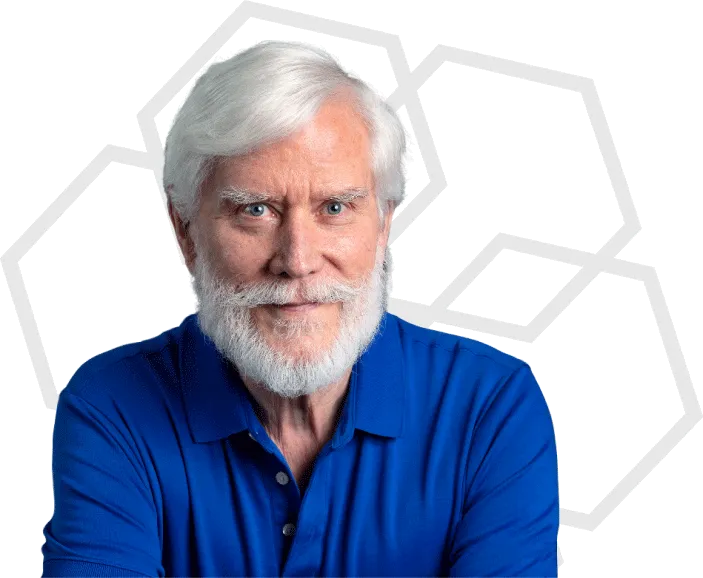
Let me introduce Tom Campbell. He is a nuclear physicist who worked at NASA, who has done more than 50 years of drug-free research into altered states of consciousness. He has worked extensively together with Robert Monroe, the founder of the Monroe Institute, where they both explored consciousness and the nature of our reality.
You might want to know more about Tom’s work with binaural beats which is sometimes called brain wave entrainment technology. Hemi-Sync is one of them.

Using scientific evidence and through systematic exploration of his own consciousness, Tom has been able to develop a scientific model of reality explaining how and why the physical world only exists in our minds. 

If you want to explore this, go to his website and read more about TOE – The theory of everything. 
https://www.my-big-toe.com/

Oh no, what are the implications if this is true?

Take a step back. 
Relax and breathe. Feel the beating of your heart in your chest. Take a sip of water.
Re-focus.

This technique, by the way, is one way to develop your emotional intelligence. Self-management and self-awareness is key.

I believe we are eternal, immortal, infinite, and universal beings having a human experience. We are here on the Earth plane to discover ourselves and right now we are wearing a space suit called a human body.

Graham Hancock, a British writer and critical thinker, says “We truly are a species with amnesia. We have forgotten a very important part of our story.”
Ram Das said we are pure awareness and love.
We are souls having a human experience, is another one.

Philosophers, poets, and artists have different ways of expressing this. 

On my podcast Transcending the Veil, I had a discussion recently with my friend and co-host Nils on spirituality. Here is the link to episode #032 The Nature of Reality: Insights into Spirituality with Claus and Nils:

Lastly I want to quote Tom Campbell from his website:

“Is this a load of nonsense? Where is the evidence? Isn’t consciousness created by the brain? How can one guy alone come up with a Big Theory of Everything?

Skepticism is the right approach. Don’t believe anything. My Big TOE is not about belief. It’s about scientific evidence, radical rationalism and first-hand experience.

But be open-minded. Always question your own assumptions. Disbelief is just another kind of belief. Consider the possibility that reality is stranger than you ever thought.”

Tom Campbell

My career break – fantastic journey of rediscovery

Wow. At dark moments during this career break I thought I hadn’t spent my time efficiently. I was recovering from a career burnout and at times it felt as if I had fallen asleep.
But today I had a look at my walls here in my room. There are a lot of new post-its and my large whiteboard has been filled many with ideas, philosophy, mission statements, concepts, and content outlines during the last two months.
I also looked at my Youtube watch history, browser history, along with the new bookmarks in my browser.

Looking at the list of activities I compiled with the help of ChatGPT I must admit I’ve been quite creative. And come to think of it, I’ve allowed myself to have the space and time needed to combine professional skill enhancement with personal development and spiritual exploration.

In Human Design, I’m a pure generator with a 6/3 profile. I’ve been deep diving into Human Design since I learnt about it in mid 2023 and I’m quite fascinated by it. Mainly to get to know more about myself and what my False self is. And how to stay true to my own design.
Pure generators are by definition very creative, and multifaceted in their pursuits and passions. My HSP traits along with my star sign Sagittarius indicate my passion for spirituality and peak human potential.

Here’s a shortened list of my current explorations.

Personal Development

  • Mindfulness and reflection: Focused on introspection and life direction.
  • Spiritual practices: Participated in an Ayahuasca healing ceremony, exploring consciousness through a lucid dreaming course by Monroe Institute.
  • Human Design and HSP studies: Explored my Generator 6/3 profile and HSP characteristics for deeper self-awareness.

Professional Skill Enhancement

  • Digital marketing acumen: Advanced my skills in SEO, Google Ads, and Instagram marketing automation.
  • Instagram profit exploration: Developed a text quote poster for automatic Instagram channel growth and monetization.
  • WordPress and content strategy: Enhanced proficiency in CMS (WordPress, Contao) , focusing on effective digital content creation and blog management.

Creative Pursuits

  • Music production: Recorded a new drumming track, blending creativity with technical skills in music composition.
  • Rhythmic exploration: Practiced drumming with darbuka and djembe, embracing cultural musical traditions.

Entrepreneurial Ventures

  • Innovative content creation: Developed content for digital marketing, including blogs and newsletters, with a focus on business and spirituality.
  • Leadership and community building: Founded a LinkedIn group dedicated to personal leadership, fostering a professional community.
  • Online income: Research of business models, lead generation, sales funnels, email marketing.

Health and Wellness

  • Mediumship and mental wellness: Started a 52-week mentorship in mental and trance mediumship, deepening my understanding and practice of mediumship and spiritual healing.
  • Burnout recovery: Prioritized meditation, holistic practices, and mindfulness, contributing to mental health and burnout recovery.

Podcast Production and Public Speaking

  • Insightful podcasting: Producing a podcast on psychics, spirituality, shamanism, healing, and human potential, enhancing my skills in audio editing, content creation, interviewing experts, and public speaking.
  • Blogging on diverse topics: Authored articles on music vibrations, the power of the mind, the hidden meaning of Santa Claus, and lucid dreaming.

Family and Personal Life

  • Quality time with family: Prioritized valuable moments with my loved ones, reinforcing the importance of work-life balance.

Course Development

  • Spiritual leadership course: Outlining a leadership course for young adults, integrating concepts of neuroscience, personal development, and spirituality.
    Digital offers will soon be available.

Continuous Learning

  • Expansive knowledge pursuits: Engaged in the mycology community, artificial intelligence, and teachings of Dolores Cannon, Bruce Lipton, Bashar, and Alan Watts. Staying abreast of current trends and ideas listening to TED Talks,

This career break has been a period of rich learning, self-discovery, and professional development. I’ve explored new realms, honed existing skills, and prepared for the next chapter in my professional journey with a renewed sense of purpose and insight.

Join me in this journey of continuous growth and exploration. You can sign up for my newsletter below to stay in touch.

Santa Claus And The Power Of The Mind

Wait What? What a stupid headline. Santa doesn’t exist!

Here is the audio version of my blog post:

Today is December 25th. In my culture people around me recognise December as Christmas time. That’s what I’ve been brought up with. Merry people, gifts, spending time with loved ones etc. And in my culture there’s a character called Santa Claus in people’s minds – or should I say that it’s a belief or idea that has been accepted as truth in a group consciousness, across the whole world even. Coca-Cola could be a main contributor to this. Coca-Cola is the most known brand in the world, and I would assume the company behind Coca-Cola finds Christmas-time very profitable since they are profiting on an image of a fictitious character called Santa Claus in red fluffy clothes drinking their product. And that keeps repeating yearly.

Every holiday season is commercialized. I might write about the marketing industry and the power of the mind eventually.

I want to give an example of how our minds work using a very current belief system being played out these days. I’m talking about Santa Claus.

Of course at one point in your formative years you wake up from the deception and lies about the existence of Santa. You realise you’ve been fooled and everyone around you is in on it. Just a simple and innocent lie. And it would be a shame to reveal it, and ruin the fun and thus you keep the illusion alive.

I can now see that awakening to our reality happens through layered levels of understanding. And it certainly requires courage to face new facts and integrate that.

We know that the physical brain grows into maturity as we become young adults. They say the brain is fully developed at the age around 28 but the mind and our understanding doesn’t grow at the same speed necessarily.

There’s stage 1 where we are taught as kids about Santa and his Naughty and Nice list. The joy of wishing and getting presents. Innocence. Not realizing that we were actually excitingly imagining ourselves already in the possession of the toy from the magazine. And if we were lucky, we would manifest it in 3D. Some people call that process the Law of Attraction.

Kids’ brains are in a constant trance state (theta wave) until they are around 8. That state of mind is also called hypnosis. And by now as adults we know from TV what skilled hypnotists can make people do. Unfortunately hypnosis is mostly known for its entertainment value.
Basically, our minds act like a sponge at this age, just absorbing everything without questions.

Stage 2 is when we find out that the white-bearded old man wearing red clothes doesn’t exist and we get confused. There’s a new gap between what we used to believe and what reality presents us with. That state of mind or confusion is what is called cognitive dissonance. That is the mental discomfort that results from holding two conflicting beliefs, values, or attitudes.

We eventually adjust to the new fact and new conversations about Santa with un-initiated are performed with a smile on our face. We might not put 2 and 2 together yet to start asking questions about it. 

My daughter, already in 3rd grade still believes in Santa – or so she lets me know. At her age, I’m probably the one being fooled and played – ha, and I like it. What if she has matured enough to be able to turn around the joke. That’ll be a hilarious moment of realization for both of us.

If you want to read more about cognitive dissonance and what it means to us in daily life, I found a nice article about cognitive dissonance:
https://www.verywellmind.com/what-is-cognitive-dissonance-2795012

Stage 3 is when we realize and mostly unconsciously accept the consequences of this idea of presents especially at Christmas time. You follow the herd and accept that it is custom to buy in on the idea of Santa. Presents don’t manifest out of the blue in this reality.

Perhaps it’s also the same stage where you realise that it takes a resource called money to acquire those presents. Effort is required on your part.

If you are curious enough you start understanding about commercial interests and you learn about marketing and advertising as you see the effects after you’ve been to your grocery store returning with a bottle of Coca-Cola.

Perhaps you start digging into the history of Santa Claus and where he comes from. You may even start noticing that ads always show Santa Claus in red and white fluffy clothes. Reindeers are often shown as well.

As you dive deeper you might stumble upon the red and white mushroom the Amanita Muscaria, mistakenly called the magic mushroom. There’s a short video produced by the BBC about reindeers consuming the mushrooms and how some shamans use their urine for getting visions and insights. The video suggests a connection to Santa Claus because of the colors of his robe.

As you start doing your own research and get more and more comfortable with experiencing cognitive dissonance assessing two opposing beliefs at the same time, you might delve into deeper aspects of life affecting you on a daily basis. Philosophy might come up as a game changer at one point.

Compassion for other people and accepting their evolution becomes part of you as you yourself evolve.

At a later stage you realise you have options. You can decide what to believe. No one has the truth and everyone just pretends to know what’s going on. Most noticeably are government officials or news anchors on TV following the same script or success stories from surgically modified reality stars shared on social media.

As you can guess, the quest for innerstanding and exploration of personal truth is never ending. That is called personal development and it’s a huge industry. Most of it is pretty superficial and short sighted, I think.

It’s a process of discovering layers of beliefs and deciding consciously what to keep and what to let go of.

The concept of cognitive dissonance, exemplified by our changing beliefs about Santa Claus, isn’t just a childhood phenomenon. It’s a pervasive part of our adult lives too. As we grow, the dissonance extends to more complex areas – our careers, relationships, and even our understanding of health and politics.

I believe we are a species with amnesia. We’ve simply forgotten our true nature. We are eternal, multi-dimensional, universal, and immortal beings having a human experience.

We already have it all. We are not humans searching for a spiritual awakening. We are beings of spirit attempting to cope with a human awakening. There’s a huge difference and it’s a mindset shift.

This is a path of empowerment, taking responsibility for your own life one step at a time as you continuously explore your personal beliefs, values, and question the reality you experience. 

But here’s the thing; you can only integrate what you know you know. Read that again. Awareness is key.

Seeking tools, seeking knowledge and gaining wisdom is essential in the process of undoing human conditioning. 

Albert Einstein supposedly said: “No problem can be solved from the same level of consciousness that created it”. I’m starting to understand that quote in a broader sense now.

The case of Santa Claus is merely a very present and tangible concept to grasp. It’s just an example of what I call practical spirituality.

Our minds are easily manipulated and the marketing industry takes advantage of this. Marketers knew how the mind works way before psychiatrists did. 

Our reality is filled with much deeper and profound mysteries.

Dive deeper into the realms of personal growth and spirituality by joining my newsletter. You’ll receive regular insights and be the first to learn about my upcoming online courses and trainings I’m developing.

Additionally, I’m exploring the possibility of offering one-to-one spiritual coaching for a more personalized guidance experience. As a newsletter subscriber, you’ll have exclusive access to these unique opportunities.

Sign up for the Newsletter at the bottom of the page.

As we wrap up this exploration of belief systems, let’s circle back to something that might seem trivial but is actually quite profound – the role of Coca-Cola in our Christmas narrative. 
Coca-Cola has painted this jolly, red-suited Santa into our minds so well, it feels as if they had a hand in scripting part of our childhood. This isn’t just marketing; it’s a masterclass in weaving a brand into a cultural tapestry. It shows us just how powerfully a clever story, told by big corporations, can become a chapter in our collective belief system. 

It leaves us with a question to ponder: In what other areas of our lives are large companies or organizations subtly influencing our beliefs and perceptions? The answer might surprise you.

The beautiful power of music

I love music. It has taken me a lot of life experience to discover how important music is to me, especially which types resonate the most.

It wasn’t until I experienced music on a psychedelic plant medicine journey that I realized how important music has been to me since my teenage years.

The realization came about when I was 40 lying in a tipi on a DMT journey and being able to see music visually with my eyes open. Beautiful colorful scenery changing and following the music I was listening to. That night in the tipi was also my first time experiencing someone playing the didgeridoo live which still gives me goosebumps thinking of that deep growling sound with unbelievable overtones. The whole experience was so profound and beautiful that I had tears of laughter and bliss running down my cheeks.

I later found out that being able to see music is called synesthesia and is reported by many on psychedelic journeys.

These profound experiences deepened my appreciation for music, a journey that began in my childhood.

In the 80’s when I was 12 my dad bought a Commodore 64. That was my first introduction to a computer and also when I heard game music for the first time. I became fascinated with electronic music. The computer also added a new dimension to using a computer, not only could I play a computer game, it could also be programmed. My older brother picked up programming very quickly and he saw the potential and started developing games for the C64. I remember hearing the game music for some of those games and I was very excited.

My fascination with electronic music from games naturally evolved into a desire to create my own sounds and melodies. I bought a Commodore Amiga and music sequencer software in English. Being a Danish kid without anyone around to explain the musical terms, I had to learn on my own. By trial and error I eventually learned how to compose my own music. I learned about tempo, patterns, various instruments and their unique sounds, rhythms, synthesizers, and the frequencies the human ear can perceive.

Artists like Jean-Michel Jarre, Kraftwerk, M/A/R/R/S (specifically the song Pump up the volume), Vangelis, Mike Oldfield, and Kitaro inspired me, among others. It was also around that time that acid house became popular and I spent a lot of time listening to the radio analyzing how the different popular songs were composed. I learnt about the concept of beats per minute BPM as I sat in front of the loudspeakers rocking my body with a stopwatch and counted the beats of the popular songs at the time. I came to understand music as patterns of sound frequencies unfolding over time.

The Commodore Amiga was also known for being the most graphically advanced computer at the time, and I saw the opportunity to express my inner visions by combining my own music with visually stunning real time animated graphics. In order to utilize the full power of the computer I taught myself the most efficient programming language to squeeze the most out of it.

Quite naturally I found other computer enthusiasts my age and I ended up gathering us in a team to develop computer music and visual arts together. I also discovered competitions throughout Denmark where teams competed to showcase their graphical and musical creations. We entered those competitions and had a lot of fun traveling around.

When my classmates spent their weekends partying and getting drunk I studied music composition, audio editing, coding practices, and learning about colors, perception and visual arts.

Looking back on that period, I appreciate the skills I’ve gained, enriching my journey in both professional and personal realms. Among these, analytical listening, critical thinking, and pattern recognition stand out. Analytical listening has deepened my appreciation of music and life’s intricate details. Critical thinking, nurtured through my experiences with programming and music, has been a guiding light in navigating complex challenges. Recognizing patterns has helped me connect diverse life experiences, offering insights that I hope to share in future endeavors. These skills, developed over time, have shaped not just my everyday life but also my explorations in the world of dreams, where music plays a key role.

Lucid dreaming opened another door in my musical journey, allowing me to experience music in ways that defy physical world limitations.

One of those experiences was when I was 20 and I had one of my first significant lucid dreams involving music. I woke up inside my dream to find myself hovering above a still lake light as a feather. At that moment, I heard ‘Play that Funky Music’ by Wild Cherry, a surreal experience of music coming from an unknown source.
At that time, unfamiliar with navigating this state of consciousness, fear of falling into the water jolted me back into my body.

Some of the other astral projections I’ve had with music have also been fantastic. I’ve played musical instruments that don’t exist in this realm.

Synthesizers made out of moving glass parts or guitars with unlimited strings that when played turned the guitar into a piano with endless electronic buttons and levers.

Four years ago, I began my journey with percussion, focusing particularly on the African djembe.

In my lucid dreams, I’ve received guidance on playing specific rhythms and techniques for using my hands to create distinct sounds on the drum.

Returning to the profound night in the tipi, my DMT journey not only unveiled the synesthetic beauty of music but also marked the beginning of a new chapter in my musical exploration. This transformative experience inspired me to curate music in a way that could enhance not just my own spiritual journeys but also those of others. It led me to create playlists that encapsulate the essence of these profound experiences, blending sounds that resonate with the soul and elevate the spirit.

Music, for me, has become more than just a collection of rhythms and melodies. It’s a gateway to beautiful transcendental experiences, a language that speaks directly to the soul. Whether it’s the deep, resonant tones of the didgeridoo or the intricate rhythms of the djembe, each piece I’ve selected carries a piece of my journey and a resonance that I hope will touch others as deeply as it has touched me.

Here are a couple of my current favorite tracks.

Dig the Didge, Rishi & Harshil

Duality, Tumbara

Remember to Breathe, Byron Metcalf

Good for drumming (playlist)

As I continue to explore the infinite possibilities of music, both in the waking world and in the ethereal realms of dreams and astral projections, I am reminded of the power of music to connect us to something greater than ourselves. It is my hope that through sharing these sounds, others too can experience the profound joy and transcendence that music has brought to my life.

As you delve into these playlists, I invite you to ponder: How does music speak to your soul, and where might it take you?

I send out a monthly newsletter all related to peak human performance incorporating body, mind, and spirit. You can sign up at the end of the page.

What is lucid dreaming or astral projection

To me it means to become aware that I’m dreaming. Waking up in my dreams and being able to control and express in other worlds. And the wonderful freedom I experience.

Imagine being able to walk through walls, levitate, fly, breathe underwater, communicate with other beings, heal and many other experiences that are only known from Hollywood movies.

And imagine how I felt after being lucid for the first time in a dream. I was so excited and I wanted more of those experiences. The existence of other states of mind was confirmed that night and a whole new world opened up to me.

This happened when I was in the beginning of my 20s. At this point I had just found out about the movie Out on a limb, by Shirley Maclaine. In the movie she had an out of body experience while sitting in a hot spring in a village near Machu Picchu in Peru. That fascinated me and really caught my attention. I wanted to have that kind of experience too. To experience other worlds – and it was achievable. I had to know more.

I came across Robert Monroe’s books about out of body experiences and how to have them. I read all of his books in a few days. He described the theory and also the sound technology used that was able to produce such results. I learnt that way about human brain waves and when we experience them. The theta brainwave frequency around 4 Hz caught my attention. I learnt about binaural beats and Hemi Sync and I found ways to produce those sounds myself using sound generator software. I started learning about different states of mind induced by different sounds. I experimented a lot with different sound frequencies and how they affected me. I wanted to have that first out of body experience.

Eventually one day, when I had let go of my expectations, it happened.

I still remember the odd feeling of seeing my own body sleeping in my bed. At first I had a false awakening and I thought I had woken up to go to the toilet. I was sitting on my bed and stood up to walk and noticed that it felt different than it used to. Somehow it made me turn around and become more aware of my surroundings. I noticed that everything was familiar in my bedroom and it was then that I saw a person laying in my bed, sleeping. A mix of fear, disbelief, joy, and confusion rushed over me when I realized it was myself. All the sudden excitement ended the experience immediately and I was back in my body.

I couldn’t believe what I had just experienced. I could now personally confirm that paranormal phenomena was real and out of body experiences in particular were even attainable.

I started chasing out of body experiences experimenting with my own set of sound frequencies and I had a handful of experiences very shortly thereafter during the nights. I managed to be able to go out of my body and experience the same 3d bedroom as my physical self but I had to deal with a lot of fear and new sensations so my OOBEs didn’t last that long. On one occasion I managed to connect to a spirit guide whom manifested in front of me in my bedroom. Too much excitement again and it pulled me directly back into my body. I woke up in my bed and started looking in the direction of where I had seen the spirit but nothing was visible.

I had a huge smile on my face because of my encounter while also feeling disappointed that I had missed an opportunity to experience my first communication with the invisible world because I got too excited.

I realized I had to learn to stay calm in those states in order to be able to do anything useful. I needed more control over my mind so I started reading about meditation, self-hypnosis, lucid dreaming, and the power of the mind. I ended up taking an education as an NLP practitioner and I got to understand myself and the physical world a bit better.

I still chased the “real” OOBE where I could see my body in my bed. All other experiences like vivid dreams didn’t matter to me. It had to be real.

At the time I was living in central Copenhagen in an apartment on the 2nd floor. There were many young people like myself living in that area.

One day in particular, I remember laying in my bed going into trance when I heard a loud roaring sound of what sounded like a large truck driving over my body. The vibrations pushed me out of my body and I was standing next to my bed in my bedroom. I kept my cool and stayed calm, just observing my surroundings. Bed, body, flooring, walls – all good. I wanted to go exploring. 

Immediately after that thought, I felt a wind that pushed me away from my body. I hadn’t experienced that before so I resisted and tried to stay in my bedroom but the wind or push was too strong. I had to stop resisting and let go.

Also, that became my first experience flying effortlessly through the brick wall to my living room and feeling the dusty mortar and the dense material of bricks. I had been pushed through a wall without getting hurt and I was floating in the living room feeling the wind becoming even stronger. I let go and decided to go with the flow and flew through several walls and other people’s bedrooms and I saw my apartment building from above, my street, the other buildings, and then everything became a haze.

I remember staying as awake and as calm as I could and when I was able to see again, I was in a primitive home carved into a cliff. When I looked around, the place felt very familiar and cozy and as a place I had once called home. I was suddenly aware of a man in the room and he called me over. He greeted me with a big smile on his face as he said “Welcome back”. He looked so familiar and I felt a rush of love flowing into me.

Bang! I was back in my body laying in my bed with my eyes wide open and still feeling the strong vibration of love. The feeling stayed with me for many days. As did the new feeling of passing through solid material as well as the awkward feeling of invading other people’s privacy when flying past them on my way through their walls.

A few days later, I started noticing a change in the vibrations I could feel when in the trance state. I found out that by letting my body get a full night’s rest, when I woke up from my sleep I kept my eyes closed and my body relaxed and I was able to roll out of my body. Sometimes I was only able to get one arm out and with that energy arm I had to pull my other body parts out of my heavy body as if they were clay. 

To this day, having experienced this many times now, I still have no clue why that happens sometimes.

As I was now more trained in achieving these states and my fears of the unknown diminished, I had better chances of exploring my local neighborhood surrounding my apartment. 

I remember a night when I could hear my young neighbors having fun in their bedroom which was just on the other side of my bedroom wall. Only the thick brick wall separated us. 

Me being curious I decided to go out of my body and slowly flow through the dusty mortar and bricks to finally reach my neighbors bedroom just letting my head peek out through the wall. They were naked and the woman was on her back with the man on top. I don’t know how long I watched but it came to a sudden halt when the young woman suddenly stared right at me.

Bang! Back into my body and I heard the couple loudly leaving their bedroom in a rush. I remember the excitement of my new adventure passing through physical matter. I also do remember the fear of being recognized on the street by the young woman and just imagining the range of thoughts going through her head. Luckily, I never met her again.

When I had let go of my expectations on how a real OOBE should be, new experiences started coming.

One morning after a full night’s rest, I was laying in my bed with my head to the wall. I had gotten used to taking advantage of the rested body and the mind awake state, so I kept my eyes closed and I made sure I didn’t move my body. Somehow it was easy for me to slip into the trance state again with the ability to go somewhere. That morning I had more confirmations coming my way.

I felt the lightness of my body and soon after I felt myself detached from my physical body but still laying in the bed. Through the wall, I saw and felt hands grabbing me on my shoulders and gently pulling my energy body through the wall, head first. By now I had enough experience with these states that I just followed along without resisting or questioning what was going on. When I had passed through my bedroom wall, I became aware of two women in gray tight silver suits holding my body and examining it. 

First of all I was disoriented because I was in a large room with ambient light and there was a silver-feeling about that place. The room felt organic and the walls alive and I felt safe. My logical mind had a hard time processing what was happening because in 3d I knew what was on the other side of my wall that I had just effortlessly passed through.

I was startled as I felt an extraterrestrial feeling about these beautiful beings. They spoke with each other in a language I understood and somehow I picked up their conversation about me. They looked at me and smiled and said  “He’s not ready yet” and then they pushed me back through the wall and into my body again.

I woke up immediately with tears of joy running down my cheeks. Contact was made. And I couldn’t help feeling disappointed as well. How dare they say that I wasn’t ready? I imagined all sorts of scenarios of visiting other planets, flying in their UFO around the universe. And they denied me that experience? How rude!

It wasn’t until days later after reflecting a lot on the experience that I noticed that I hadn’t seen them move their lips when they spoke. I got goosebumps when I realized I had just first handedly experienced telepathy.

Also in that apartment, I had another really fascinating encounter with non-human entities. It was early morning and I gathered that I had just come out of a sleep cycle and it was too early to get up. So I decided to stay in my bed, closed my eyes and drifted into the trance state that I had gotten used to.

Shortly thereafter I heard two high pitched voices in my bedroom. WIth my energy body, I raised my head to see if I could see anything unusual in my bedroom. Everything looked normal to me and I couldn’t understand where the voices came from. Suddenly two small human looking kids walked through the wall, still having a casual conversation and they walked up to me intentionally and stood beside my bed. They were the size of small children at the age of 5 years but when I looked at their faces, a lot of wisdom and love was emanating from their eyes. One was female and the other one male. They wore normal clothes and were perhaps a bit chubby. Almost like adult dwarves but shorter.

They weren’t surprised that I could see them. It felt as if I was supposed to meet them because they told me a story about how proud they were of me and my progress.

My logical mind kicked in and still being a bit unfamiliar with these unusual experiences I started asking questions about their intentions. I remember asking if they came from the light, which I understood as something divine and loving opposed to the dark side. The female was a bit surprised by my question and I got the distinct feeling that they didn’t have any idea what I was talking about. As if evil or darkness was an unknown concept to them. I remember feeling a bit ashamed of asking but I also felt a relief that such limitation was solely my own and darkness and light might just be a human conditioning thing.

Both of them gave me the impression that I was known in the universe and that I was loved and appreciated. I also got the feeling that my progress was being monitored and somewhere in the universal community my progress was being celebrated and they were the messengers that day.

Again I was baffled and I just went with the flow of the event. After that I let go and stopped trying to predict what would happen afterwards. After they had delivered their message to me, they wandered off again cheerfully out of my bedroom from where they came – through the wall to my neighbor.

Again, I woke up with tears of joy in my eyes, totally confused and happy at the same time. I got out of my bed and decided to check the part of the wall where they had walked through. Solid, of course.

Because of the nature of that experience I only shared it with a few people with whom I felt safe. The fear of being ridiculed became apparent to me but luckily it didn’t stop me from exploring further.

Looking back at these kinds of experiences 30 years later, I’ve come up with some tips and tricks on how to achieve these states of mind. Most of it is about your mindset and your approach; becoming aware of limiting beliefs and the ability to let go.

How to astral project

The freedom you can experience when you are in control of your dreams… Oh, all those adventures waiting ahead. But, how do you actually astral project and what are the steps to achieve it?

My first tool I used was the audio cassettes from The Monroe Institute, for the Gateway Experience program. And I had read the books so I knew what to expect when listening to the tones in my ears. The Monroe Institute called the sound technology Hemi-Sync and I liked exploring this sound technology with headphones.

I had beautiful experiences when I finally let go of my expectations and some of the heavier fears about the unknown territory I was exploring.

Fear is a killer and affects us in many ways including our ability to explore astral projection. For me it was a balance between my hunger for adventure and my fear of the unknown. 

One of the tools I learnt about to deal with fears was a technique invented by Robert Monroe, where you use your imagination to create a safe place to store the bad stuff. It is a mind tool he called an Energy Conversion Box in which you put all your concerns and fears so they don’t distract. That is one of the first steps in his method. Also as part of the first steps, Robert speaks these powerful words: 

“I am more than my physical body. Because I am more than physical matter, I can perceive that which is greater than the physical world.

Therefore, I deeply desire: to expand, to experience, to know, to understand, to control, and to use such greater energies and energy systems as may be beneficial and constructive to me and to those who follow me.

Also, I deeply desire the help and cooperation, the assistance, the understanding of those individuals whose wisdom, development and experience are equal to or greater than my own.

I ask for their guidance and protection from any influence or any source that might provide me with less than my stated desires”

Recently at a Monroe course I met someone who had invented a suction function on the energy conversion box so all interfering stuff was automatically sucked into the box. That’s power of the mind and practical imagination.

Talking about sound technology, there are several other sound experience options on Youtube if you search for binaural beats or isochronic tones.

Every day practices

In astral projection you have no physical body. The mind however manifests the body in our dreams including our assumptions about physicality. We’re here to bust the assumptions.

Let me explain something I call reality checks or dream triggers. It’s a learnt behavior that when observed and experienced in a dream can trigger you to realize you are dreaming.

Do these exercises as often as you like. Repetition is the key here. I’ve found out that we take memories of our daily activities with us when we are dreaming. If you perform these reality checks several times a day, you will most probably be repeating them in your dreams as well – but with unexpected results and that is what we are looking for. That will trigger you and awaken you in the dream world.

Here are some of my go-to reality checks.

You can pass through walls effortlessly if you decide to. Place your hand on a wall and push it through the wall with the intention to penetrate it. Repeat several times. If your hand disappears into the wall, you’re dreaming and can go exploring.

This one is an easy practice you can do without looking like someone whom was just released from a mental institution. It’s called finger through palm. Try to push one finger through your palm.

Clocks and texts on signs and street names in the astral projection experience is another anomaly. In your everyday life, make it a habit to read things with texts on them like street names or bill boards. First notice the street name and then look away and read the sign again. If the text has changed, it’s a clear sign that you’re dreaming. Or drunk. 

Look into a mirror. Your reflection looks different or distorted in dreams. As a side note, I can attest that mirrors are magical. Portals if you dare to imagine it.

Wave your hands in front of you and then count your fingers. If you don’t get the expected result either visually or when counting, you’re on your way.

Reality checks can be done at all times when you remember it. As I said, repetition is key.

Game: Learn the Scrum Guide – WeAreScrumTrainers Inc.

For this game, people need to come prepared as they will use the Scrum Guide intensively during the game play. Have the participants read it before playing.

Ask people to bring their laptop so they can access the Scrum Guide during the game play.


Overall outcome of the game

Understand the Scrum Guide & inspire participants to read it and understand it by playing this game.

The Startup company “WeAreScrumTrainers Inc.”

Agenda

Me: 3 min – Introduce the Scrum Guide – people will have to bring their laptop to read it!
Me: 1 min – Introduce the theory of team size (4-5 people excluding SM and PO – according to Harvard Business Review)
Me: 5 min – Game introduction – We are a newly established startup company – main service is providing Scrum training to other companies

I’ll act the CEO/PO and keep track of time.

Our company vision

Our company is called WeAreScrumTrainers Inc.

Our customers want Scrum training. We want to provide the best Scrum training on the market.

The product (The what)

Our customers want to buy posters from us containing the essence of Scrum.
Our company must provide that product before lunch today!

The Product Owner’s acceptance criteria

Every team must produce 1 poster per sprint with a chosen topic from the Scrum Guide.

Every presentation topic must be unique and must not overlap with other team’s presentations. (We don’t want waste!)

Every team must do a timeboxed 1 minute presentation at the Sprint Review and Demo.

Each presentation must be readable and understandable by the other teams.

The structure (The how)

Organize the work using Scrum.

Work in short sprints

Form Scrum teams (self organise!)

2-3 sprints in total, due to time constraint.

Sprint length: 12 minutes in total:

  • Sprint planning, 2 min
  • Execution, 8 min
  • Retro, 1 min
  • Sprint review and demo, 1 min for each formed team
  • + time for each team’s presentation
  • + time for sharing of learning experiences (How can we use this “back home” in our own teams?)

Expected learning objectives of the game

  • self-organisation
  • (the value of having a “Definition of Done”)
  • cross team coordination
  • working in timeboxes (sprints)
  • (estimations?)
  • the value of planning
  • the value of retros
  • the company wide celebration of product delivery!!!

Facilitation of the game

We will form x number of teams. Each team must have access to posters and whiteboard-pens for their presentations.

Team needs an identity (a team name, slogan, whatever)

The Scrum Master’s field guide to a newly formed scrum team – first steps

The Scrum Master

The Scrum Master's field guide

This guide is a list of suggestions you can implement as a Scrum Master when you are joining a newly formed Scrum team. However, many of the suggestions described here may be useful in case you become Scrum Master for an existing scrum team.

First things first

In general, avoid using buzzwords when you explain the events and artifacts in scrum. Use your own words — it deepens your understanding too. Use planning for life events as examples everyone can relate to; planning a birthday party for example.

Remember to be patient. It is a newly formed team and it takes time for people to understand a new way of working. Don’t expect them to get it quickly — consider how long it’s taken you to get to your level of understanding.

Be kind, be respectful, be fair, be firm. You are there to help them, support them, and guide them on your mutual learning journey.

Be honest and transparent about your work, your observations, your thoughts.

Listen to your team. Listen to each individual team member. Listening is an essential part of your work.

Listen with the intent to understand,
not to respond.

Stephen Covey

Don’t become the bottleneck in your team’s learning journey by taking on tasks they should do just because you want them to accept or respect you. It might have the opposite effect entirely.

Expect to make mistakes. Make amends, learn from them, share the learnings with others. Move on. You’re only human after all.

Do a regular health check of your own ways of working with the team. Ask for feedback from your team members and your peers. Adjust. Take your own medicine and take ownership of your own development.

Mindfully choose where and how your effort can give the most impact for your team. Learn from your peers. Study. Reflect. Experiment. Adjust.

Stay humble. Stay curious.

Lead by example.

How to read this guide

Reading the official Scrum Guide again is always a good idea. You will probably find new things you haven’t noticed before? Now is a good time to refresh your memory.

This guide here doesn’t replace the Scrum Guide but acts as a companion.

In the sections below I mention the tool JIRA which is an electronic tool for managing the product backlog items and the sprint backlog. Any tool will do — even paper based ones. JIRA is not a necessity.

Also, when I mention user stories in this guide it represents work to be done. These items are called artifacts in the Scrum Guide.

In a Scrum team there are three roles; The product owner (PO), the development team, and the Scrum Master (SM). In my personal view the PO and the SM are full time positions and they should not be part of the development team executing the sprint backlog. Note here, that the Scrum Guide mentions the PO and the SM as roles, not positions — and thus leaving any variation open.


Initial steps

The Product Owner

Start by talking with the PO about the roles and responsibilities of each role in a Scrum team.

  • Provide a link to the scrum guide section on the role of the product owner.
  • Send the PO the article “4 Daily Scrum Tips for Product Owners” by Roman Pichler. Read it yourself as well…
  • The PO must be reachable; In the name of collaboration, the development team and the PO will need to collaborate on a regular basis on reviewing work done by the development team – as well as the team’s understanding of the items in the product backlog.
  • The PO and the development team must share a common understanding of the work to be done. Having acceptance criteria in the user stories helps greatly with this understanding.
    At the end of the sprint if the work done didn’t have the expected impact, it’s up to the PO to create a new user story in the product backlog with the desired outcome and proper description. The development team is not to blame for misunderstanding the user story.
  • There is no need for the PO to approve or accept the user stories once they’ve been pulled in the sprint by the development team. The development team decides how to achieve the described outcome.
  • Tell that the PO could benefit from listening in on the daily scrums to get a sense of the team’s work progress towards the sprint goal. Note it’s not mandatory for the PO to come to the daily scrum.
  • The PO must continuously work on preparing upcoming work; Clarify the understanding that the PO is to define and create the product backlog items as preparation for the upcoming sprints.
  • The PO must prioritize the product backlog regularly based on customer feedback and business needs.
  • Have the PO think about a product vision for the Scrum team which can be presented and discussed in the session on alignment of expectations.
  • Build a good and healthy relationship with the PO.
  • You are there to guide, teach and protect.
  • Like you, the PO is there to protect the team from outside influences.
  • The PO is funding the product development being done by the team.

Alignment of expectations

Book a session with the entire team about alignment of expectations to the three different roles in a scrum team.

  • Have the PO present the initial product vision for the team. Have the team reflect on it, discuss and agree. Document it somewhere visible on a wall next to the team.
  • As preparation for the meeting, provide a link to the Scrum Guide section on the Scrum Team.
  • The purpose of this session is to give the team an overview of roles and responsibilities.
  • Discuss expectations to you as their SM as well as development team’s expectations towards each other and the PO.
  • Discuss and document team working agreements. Write the agreements on a big poster together with the team and hang it up afterwards beside the team.
  • Take notes for yourself on each team member’s expectations to you. Those notes come in handy afterwards, so you can customize your teachings to those team members specifically based on their needs.
  • Have the team come up with a good team name. Delegate the creation of the team banner. Let them take ownership of their new identity.

Lead by example

  • Tell them that you are there to support them in creating value to the customers. You are not part of developing the product or responsible for the delivery of the product. You are a facilitator and a process holder.
  • Tell them you will set up a structure for them to work within in terms of tools and processes.
  • Tell them in order to constantly improve, you will help them evaluate ways of working in the team on a regular basis. This also includes evaluation of the collaboration with the rest of the organization surrounding it.
  • Tell them that you expect the development team and the PO to take over these tasks and ownership of them eventually. As a SM you may not be able to or wish to attend all scrum events.
    Those tasks include their daily use of JIRA, the writing of user stories after sprint planning, and them removing roadblocks/impediments.
  • Include team members in all the work you do for them, especially show them how you help remove impediments.

Session on ways of working

Set up a session with the new team on ways of working. Come prepared with posters of the different Scrum events. Make them beautiful.

Even prepare a few quick games for the team to learn about requirements, communication and collaboration.

The outcome of this session should be that the development team and the PO share a common understanding of the events and artifacts in scrum;

  • The why
  • The when
  • The frequency
  • The who does what etc.
  • Especially the end-to-end value creation responsibility of the development team
  • Explain the cycle in scrum; sprint planning, daily Scrum, product backlog refinement, sprint review, and sprint retrospective.
  • Explain that you will help them calculate the team’s sprint capacity based on their availability.
  • This first calculation only acts as a starting point. We must start somewhere, right?

Facilitate the creation of the team’s Definition of Ready (DoR)

  • The DoR documentation is created and maintained by the Product Owner in close collaboration with the development team.
  • Get the team members involved in the creation of a poster. Hand one of them the whiteboard marker. Watch the magic happen.

Facilitate the creation of the team’s Definition of Done (DoD)

  • Facilitate the creation of a definition of done for the team’s work.
  • Explain what it is
  • And why it is needed. It gives us satisfaction when our delivery lives up to all the acceptance criteria.
  • Involve the team members in the creation of the poster.
  • The DoD documentation is created by, maintained by and is for the development team.

The development team must check that the work they’ve completed must live up to the acceptance criteria defined in the sprint backlog item. This task should be a natural part of the team’s DoD.

Production incidents, bugs and defects

Explain that production incidents always take priority over any work in progress in the active sprint.

  • Adjust the sprint backlog items accordingly.

Defects found in the work developed in the active sprint are to be solved in the active sprint. “Working software” at the end of the sprint is the main goal.

  • The user story status is changed back to in progress.

Bugs found in work finished in a previous sprint are to be:

  • documented
  • and added to the product backlog for prioritization.

Anyone in the scrum team can add stories to the team’s product backlog.

On the sprint planning event

Only stories that live up to the DoR can be pulled;

  • Let the PO and the development team know that only user stories that meet DoR can be pulled in the sprint. Refinement of user stories in the sprint planning should not take place unless requirements have changed since last backlog refinement session.
  • It is up to the development team to determine if they are comfortable pulling the user story into the sprint.

Sprint goals;

  • Explain that a sprint goal acts as a guiding star during the entire sprint as to what the outcome should be.
  • Only user stories that accomplish the sprint goals should be pulled in and worked on in the sprint.
  • In scrum the PO defines the sprint goal before or during the sprint planning.

Tell them about the use of estimation of user stories;

  • The use of Fibonacci number sequence to reflect risk and work effort;
  • Relative sizing
  • and perhaps the use of reference stories.

As part of the first sprint planning event teach the team how estimation can be done. Or even better, at the first backlog refinement session.

Just remember that the use of story points is not part of the official Scrum Guide.

On the daily scrum

Tell them about the timeboxed event;

  • Max 15 minutes for the team to update each other on the progress towards the sprint goal.
  • Explain why it’s not a status meeting.
  • Explain who from the scrum team must participate (the development team) and who can attend (the PO, and other stakeholders).
  • Tell them that you will start facilitating the daily scrum, but you will hand over the responsibility to the development team after a while.

On the backlog refinement sessions

Align expectations on the level of details in the user stories.

  • The PO must convey just enough information for the development team to understand the customer needs.
  • PO must provide contact information where the team can get more information.
  • Analysis and requirements gathering is part of the development team’s daily work.

Tell the team that as part of the product owners’ preparation for the product backlog refinement sessions, the PO may occasionally need help from a team member to refine a user story. Explain this to the development team as it’s part of their work during a sprint.

Explain that the outcome of the backlog refinement sessions is that:

  • the top priority product backlog items live up to the Definition of Ready (DoR) and thus ready to be pulled.
  • And of course, that the development team understands the desired outcome of the user stories.

Tell the development team that it is a good practice for the development team to look at the top prioritized product backlog items together before the refinement session to familiarize themselves with the content. This speeds up the backlog refinement sessions.

On the sprint review session

Tell them that the development team and the PO should remember to set aside time for preparation of the sprint review;

  • Who in the team should present what and how.
  • Preparation time is part of their daily work.

The PO is responsible for inviting relevant stakeholders to the sprint review. Help the PO explore and define who are the main stakeholders to invite.

The Scrum Master protects the team

Don’t disturb!

  • Any direct request from outside the team to a team member must be directed to you as Scrum Master or preferably to the PO.
  • Respect their time. They need focused time to be creative and do their job skillfully.

Protect against scope creep

  • Explain that you will try to ensure that scope creep doesn’t happen during the active sprint; What the development team committed to do should stay untouched.

The Scrum Master helps the PO

Health check of the product backlog:

Tell the PO that you will help do a health check of the product backlog items regularly in terms of definition of ready. Not to challenge the needs described but to

  • ensure a proper item size
  • and proper description
  • and well-defined acceptance criteria
  • ensure that all items have business value
  • perhaps make use of the INVEST or SMART ways of describing the work needed

Also, explain that you will help the PO ensure that the product backlog doesn’t become too large, and thus loose the overview of the outcome that we want to achieve.


The first few sprints

As a good practice, ask the team why we have these events. Let them explain and explore. If you don’t get the response you expect, explain.

The sprint planning — “Get in. Get out. Get started.”

The purpose of sprint planning is to select a set of product backlog items to work on and have a rough idea of how to achieve them.

The sprint backlog is a forecast made by the development team based on the knowledge they had at the time of sprint planning.

The PO explains the top priority backlog items briefly. The development should be familiar with the items already.

As your preparation for this event, read Mike Cohn’s article about the sprint planning event. You might want to share the article with the team for their understanding.

Bring the excel spreadsheet with the calculated sprint capacity. Remind them that the capacity calculation is a best guess at this point.

Have the team calendar readily available to look at.

For an explanation of the capacity calculation and the team calendar, see the section below called “One-time administrative tasks”.

On estimation:

  • Remind the team that we start up with using man days as story points.
  • Help the team estimate the user stories/items one at a time.
  • Use the Fibonacci number sequence 1,2,3,5,8,13 etc.
  • Help the team split the user story if estimations are too high. Split by acceptance criteria?
  • Ask the team to assess if splitting user stories into tasks makes sense
    If needed the development team may break the user stories into tasks. Sometimes it makes sense to estimate the tasks in hours. As a rule of thumb, a single task should never exceed a working day.

Help the team do a sanity check. Using the team calendar, help them assess if the pulled items makes sense in terms of the team calendar.

Do a confidence vote at the end of the sprint planning. Facilitate a discussion in the development team if the team is not confident. Adjust sprint backlog accordingly.

The daily scrum

Show them where to find the sprint goals.

  • Remind them to align their work to it.

Are we on track?

  • On a regular basis make them used to assessing whether they are able to meet the sprint goal.
  • Address any concerns to the PO.

Avoid detailed discussions. It’s a planning and alignment session.

  • Ask if this is something that can be discussed afterwards.

Make sure you only spend a maximum of 15 minutes. Stop the session after 15 minutes.

The event is an opportunity for a team member to ask for help

  • If a user story has been in progress for a long period of time, remind them to reach out for help in the team.
  • Keep track of how long a given user story is in progress. Electronic tools like JIRA have that functionality. If you have the individual user stories written on paper, simply put a dot on the post-it every day while it’s in progress.

Teach the team to use and look at the team calendar regularly as part of the planning.

  • Any planned leaves, holidays, sprint review coming up that affects the planning?

Ask the team about any updates on the action items from the latest retrospective.

At the end of the event share your observations. What went well, what was unhealthy team work etc.

Can the event be improved? Kindly nudge the team if you can see that they can improve ways of working here. Ask them if the session was valuable and what could be improved. Adjust.
The daily scrum is a great opportunity to gather facts about our WoW.

You should facilitate the daily scrum for the first two or three sprints and then gradually step in the background. Remember to involve your team in that decision early on.
After that, observe how the development team ensures that the event is executed and how. Support them if needed of course.

The backlog refinement

  • The PO presents the contents of the product backlog items.
  • Development team asks questions to clarify.
  • Clarifications and decisions on scope etc. must be documented in the user story.
  • Any team member can update the user story. It isn’t restricted to the PO.
  • Update the user story on the fly. Don’t wait.
  • If needed, remind them of the Definition of Ready
  • At the end of the session, ask the development team if they are confident in pulling the items in their current state.

The sprint retrospective

The sprint retrospective is the most important event in scrum. It’s a time where the whole scrum team gathers and has dedicated time set aside for discussing improvements.

Make the retrospective fun for all of you. Prepare a new format that inspires you. Your passion will be reflected in the team.

  • Don’t obsess about a specific format. The discussions taking place are the most important.
  • A retrospective can be held in a café or while walking two and two.

Make it a safe place to talk and share. What happens in the retrospective, stays there.

Use energizers and make use of a break if necessary.

Bring the poster about the team working agreement if needed.

Ensure that team members bring action items from previous retrospectives.

  • Hold the development team accountable for the implementation of those action items; never a single person.
  • Have the team give an update on those action items.

Bring the burndown chart. Explain how to read it and discuss the actual sprint progress.

Bring the CFD chart as well. Explain it and discuss it.

Topics: be bold and courageous. Talk about the noisy pink elephant in the room!

Help the team narrow down max 2 action items which require little effort but has high impact.

  • Every action item must be assigned a driver/lead. As a SM don’t assign it. Ask the team.
  • Make sure that it doesn’t necessarily get assigned to the person who brought it up.
  • Don’t assign tasks to yourself. You don’t want to become a bottleneck.

Don’t let the team postpone the retrospective because they are too busy. Being too busy is a good problem to discuss at a retrospective. Of course there are unusual situations that may require rescheduling the retrospective.

Remember that the retrospective should be enjoyable by all team members. Even the scrum guide mentions this =)

Remember to celebrate your success as a team.

The sprint review

As preparation for the sprint review, read these articles:

Make sure the team collects feedback from the stakeholders during the event and let the PO and development team assess if they should create new user stories in the product backlog based on the feedback.

Inspect and adapt

Was this session valuable to you? At the end of these events, ask the team to do a quick evaluation of the session. Adjust ways of working accordingly.


One-time administrative tasks

Set up a common team calendar:

  • Set up a dedicated Outlook team calendar for invites and scrum events, separate from your own. Read this article on why and how to set it up:
    “Scrum Events: Who sends out the meeting invitations?” Posted on Scrum.org
  • Explain that it can be used for planning purposes by team members by entering absence or planned leave.
  • Sprint start and end dates can be added in the calendar too.
  • Find and book the same meeting room for all the events if possible. Or at least make sure the daily scrums are at the same place and time every day.
  • Remember to add Skype or MS Teams link in every invite.
  • Remember to clearly describe in the meeting invite the purpose, agenda and outcome of the scrum events — and who must participate and who should attend.

From that team calendar, create the following invites for the next 3 months:

Daily scrum or whatever frequency you and the team decide — as often as necessary.

  • Timeboxed to 15 minutes.
  • Find a time of day that suits the entire team. Take time zones into consideration.

Mid sprint review if necessary — or do it as part of the daily scrum — Are we on track?

Product backlog refinement session(s)

  • Duration maximum 1 hour per session.
  • Book two sessions for a two-week sprint.
  • At least have a backlog refinement session as close to the next sprint planning as possible.
  • This ensures that the development team has the content fresh in mind so a repetition at the sprint planning can be kept at a minimum.

Sprint review

  • Coordinate with other teams when to have the sprint review as they might require feedback from the same stakeholders as your team.
  • Have the sprint review on the last day of the sprint.

Sprint retrospective

  • Have the sprint retrospective on the last day of the sprint or at least before the upcoming sprint planning.
  • Timeboxed to 1 hour for a 2 week sprint.

Team calendar
Have a short session with the team about the shared calendar explaining what it is, show how it is to be used. Let the team do a test run.

Calculate the team’s sprint capacity – best guess

Ask the development team to inform you of any leaves or vacation for the upcoming 3 months.
Based on that, create an Excel spreadsheet where you can calculate the development team capacity for the next 5–6 sprints.

  • Never include your capacity as Scrum Master. You are not part of the development team.
  • Don’t include the PO’s capacity either unless the PO takes part in the daily work executing the sprint backlog.
  • Remember to take public holidays into account — and if you have team members in other countries, include their public holidays too.
  • Per sprint, calculate the total sum of man days available in the team.
  • Use only 60% of that maximum in each sprint as a starting point for sprint capacity. This leaves a 40% buffer for participating in the scrum events and other tasks.

Setup a physical sprint board

Set up a physical sprint board close to the team.

Discuss with the team which columns or states to include on the board.

If the team also has an online sprint board, make sure to tell them to update their progress there too. We never know whom of our stakeholders might want to follow our progress.

Setup a sprint board in JIRA

Ensure all team members have access to JIRA. Show them where to order access themselves.

Create the upcoming 5–6 sprints in JIRA for the team so they are visible to the development team — especially the PO can benefit from that overview.

  • Good practice: Naming convention for a sprint “Sprint 1–13/1–27/1”. This way they can always see when the sprint ends when looking at the “active sprint” view in JIRA.

Remember to give the PO admin access rights so the PO can start and complete or cancel a sprint in the tool. You don’t want to become the bottleneck.

Have a session with the entire team where you show them how to use JIRA;

  • creating user stories (issues) and moving them to the different states in the scrum board
  • starting and completing a sprint

Tips and tricks

TIP: On the backlog refinement session try having the development team present the user stories to the PO. This makes the development team feel ownership of the product. Also, any misinterpretation will be apparent to the PO and the phrasing of upcoming backlog items can be adjusted accordingly.

TIP: Advanced topic: When the team matures, you may want to suggest to the team that they estimate the user stories already in the backlog refinement session instead of in the sprint planning. And then keep the last refinement session as close to the following sprint planning as possible, so the user stories are fresh in mind. That way the sprint planning session can be executed quickly as no repetition nor estimation is needed.

TIP: During the daily scrum, have a team member follow up on the action items from the latest retrospective instead of you.
Before the daily scrum ask a team member for help. Instead of you following up have a development team member do it for you.
This has several benefits:

  • You teach the team member to be aware of the improvements that they decided to implement.
  • Secondly when someone gets the question from a fellow team member to whom the team member is accountable, the team member will make an effort to implement the improvement as agreed.
  • Finally, by you involving a team member that way you show them a simple but effective technique of holding each other accountable for the work in the team.

Good practice: You want the development team to calculate the team’s sprint velocity.

In terms of predictability, it makes good sense to have an idea of how much work can be done in a typical sprint. Stakeholders and the PO should be particularly interested in this information.

In the beginning it’s perfectly fine that you come up with a way to estimate their sprint capacity, but you want the development team to take that responsibility as soon as possible. You don’t want to become a bottleneck or impediment on the team’s path to self-organization.

  • After the first three sprints you should be able to find a trend in the amount of user stories or amount of story points accepted in each sprint.
  • Involve the most critical team member in this analysis in order to on-board that team member and have the team member take ownership of the calculation.
  • Ask the critical team member for advice on how to predict the sprint velocity based on the previously accepted work. Scrum is all about empiricism.

Enjoy the magic.